
Last updated: October 9th 2026 | Reading time: 14 minutes
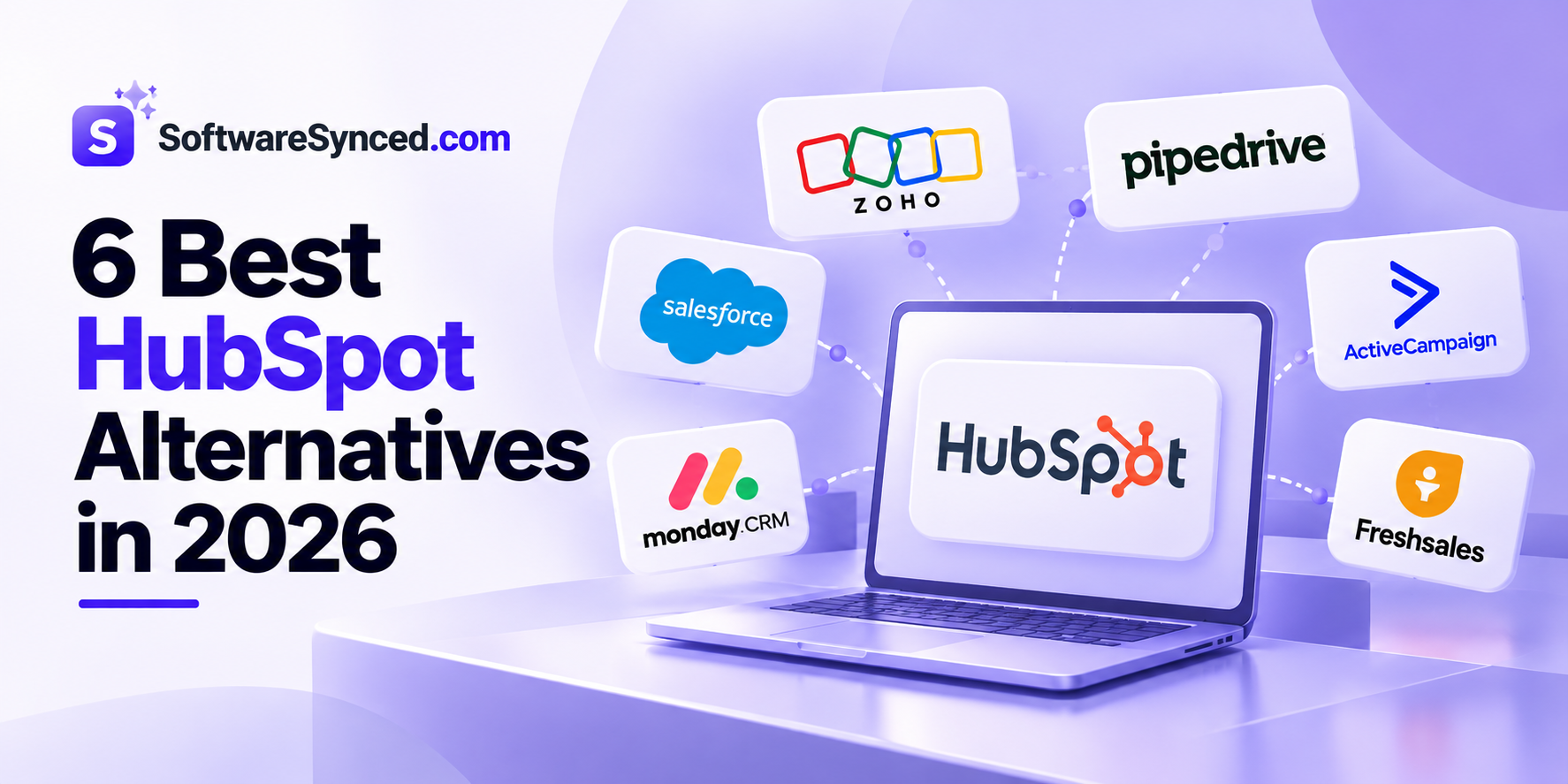
The best HubSpot alternatives in 2026 are Zoho CRM, Pipedrive, ActiveCampaign, Freshsales, monday CRM and Salesforce Starter Suite. Zoho CRM is the best overall pick. It costs 80% less than HubSpot Sales Hub Professional in year one for a five-person team.
Cost is the main reason teams switch. HubSpot Sales Hub Professional costs $90 per seat per month on annual billing. It also carries a mandatory $1,500 onboarding fee. A five-person sales team pays $6,900 in year one before any add-ons.
This guide compares each alternative on price, features and trade-offs. It also shows the real year-one cost for the same team size. For a wider view of the market, see our guide to the best CRM software.
TL;DR: The Best HubSpot Alternatives
Zoho CRM is the best overall HubSpot alternative, with a free plan for 3 users and paid plans from $14 per user. Choose Pipedrive for pipeline-focused sales teams and ActiveCampaign to replace HubSpot Marketing Hub. Pick Freshsales for built-in calling and monday CRM for visual workflows. Salesforce Starter Suite suits teams planning to scale into enterprise CRM.
Quick Comparison
| Tool | Best for | Starting price (annual billing) | Free plan or trial |
|---|---|---|---|
| Zoho CRM | Best overall value | $14/user/month | Free plan for up to 3 users |
| Pipedrive | Pipeline-focused sales teams | $14/seat/month | 14-day free trial |
| ActiveCampaign | Marketing automation | $19/month (1,000 contacts, monthly billing) | 14-day free trial |
| Freshsales | Built-in phone and calling | $9/user/month | 21-day free trial |
| monday CRM | Visual workflows | $12/seat/month (3-seat minimum) | 14-day free trial |
| Salesforce Starter Suite | Teams planning to scale | $25/user/month | Free trial |
| HubSpot (for reference) | All-in-one marketing and sales | Sales Hub Professional: $90/seat/month + $1,500 onboarding | Free plan for up to 2 users |
Why Do Businesses Look for HubSpot Alternatives?
Businesses look for HubSpot alternatives because HubSpot’s costs rise sharply after the Starter tier. The Professional plans add per-seat fees, mandatory onboarding fees and annual commitments. Marketing Hub also charges by marketing contacts. As a result, a growing team pays more each time it adds a user or crosses a contact limit. HubSpot remains a strong platform, but the price gap between Starter and Professional pushes many small teams to compare cheaper CRMs.
HubSpot’s own pricing pages show the size of that jump:
| HubSpot plan | Price | Onboarding fee | What’s included |
|---|---|---|---|
| Free CRM | $0 | None | Up to 2 users and 1,000 contacts |
| Sales Hub Starter | $20/seat/month (monthly billing) | None | 500 HubSpot Credits, up to 50 sales workflows |
| Sales Hub Professional | $90/seat/month (annual) or $100 (monthly) | $1,500, one-time | Forecasting, sequences, up to 300 workflows |
| Sales Hub Enterprise | $150/seat/month | $3,500, one-time | Team-level forecasting, up to 1,000 workflows |
| Marketing Hub Professional | $800/month (annual), 3 seats | $3,000, one-time | 2,000 marketing contacts |
| Marketing Hub Enterprise | $3,600/month, 5 seats | $7,000, one-time | 10,000 marketing contacts |
Prices from HubSpot’s Sales Hub and Marketing Hub pricing pages, checked October 2026. HubSpot also shows promotional Starter pricing from $7 per seat.
Contact limits add a second layer of cost. Marketing Hub sells extra contacts in fixed blocks. A Professional account that grows from 2,000 to 2,100 marketing contacts pays for a full extra block. That finding comes from a July 2026 pricing breakdown by Carly.
How Much Does a HubSpot Alternative Save?
A HubSpot alternative saves a five-person sales team between $900 and $5,520 in year one. The table compares each tool’s closest plan to HubSpot Sales Hub Professional. Each plan includes core sales features, such as pipelines, automation and email tools. HubSpot’s total includes the mandatory $1,500 onboarding fee. The calculation uses annual billing, five users and 12 months.
| Tool and plan | Price per user/month | Seat cost (5 users × 12 months) | One-time fees | Year-one total | Saving vs HubSpot |
|---|---|---|---|---|---|
| HubSpot Sales Hub Professional | $90 | $5,400 | $1,500 | $6,900 | – |
| Salesforce Pro Suite | $100 | $6,000 | $0 | $6,000 | $900 (13%) |
| Pipedrive Growth | $39 | $2,340 | $0 | $2,340 | $4,560 (66%) |
| Freshsales Pro | $39 | $2,340 | $0 | $2,340 | $4,560 (66%) |
| monday CRM Pro | $28 | $1,680 | $0 | $1,680 | $5,220 (76%) |
| Zoho CRM Professional | $23 | $1,380 | $0 | $1,380 | $5,520 (80%) |
Features differ between these plans. HubSpot Professional includes forecasting and up to 300 workflows. Check each tool’s plan details against your team’s must-have features before switching. ActiveCampaign is not in this table, because it prices by contacts rather than by sales seat.
How We Evaluated These HubSpot Alternatives
We compared each tool against HubSpot on the factors that drive switching decisions. Pricing was checked against each vendor’s pricing page or a dated pricing source in October 2026.
- Year-one cost: Seat prices, onboarding fees and add-ons for a five-person team.
- Sales features: Pipelines, automation, forecasting and email sequences.
- Marketing features: Email campaigns, automation and contact-based pricing.
- Free plan or trial: How far a team gets before paying.
- Scalability: The cost and effort of growing into higher tiers.
1. Zoho CRM – Best Overall HubSpot Alternative
Price: Free for up to 3 users; paid plans from $14/user/month (annual)
Best for: Small and mid-sized businesses that want deep features at a low price
Zoho CRM is the best overall HubSpot alternative because it combines a free plan, low per-user pricing and deep customization. The Free edition covers up to 3 users. Paid plans start at $14 per user per month on annual billing. The Professional plan costs $23 per user. That plan adds AI agents, predictive intelligence, inventory management and unlimited reports. Zoho CRM also connects to the wider Zoho suite, such as Zoho Books, Zoho Desk and Zoho Campaigns.
Zoho’s Standard plan already covers most small sales teams. It includes multiple sales pipelines, sales forecasting, built-in calling, mass email and custom modules. Integrations with Slack, Zoom and Microsoft Teams are also included. The Enterprise plan costs $40 per user and adds multi-team management, approval processes and a developer sandbox.
| Pros | Cons |
|---|---|
| Free plan for up to 3 users | Interface takes longer to learn than simpler CRMs |
| Professional plan costs $23/user/month | Deep customization needs setup time |
| Forecasting and multiple pipelines on Standard | Best value depends on using other Zoho apps |
| Connects to the full Zoho business suite | Contracts auto-renew, so track renewal dates |
The honest trade-off: Zoho CRM’s depth comes with a steeper learning curve. Small teams without a dedicated admin spend extra time on setup and configuration.
Best for: Cost-conscious teams that want enterprise-style features without enterprise pricing.
Not ideal for: Teams that want a CRM running in an afternoon with no configuration.
2. Pipedrive – Best for Sales Pipeline Management
Price: From $14/seat/month (annual)
Best for: Sales teams that manage deals through clear pipeline stages
Pipedrive is the best HubSpot alternative for sales pipeline management because every screen is built around moving deals forward. Deals sit on a visual board with drag-and-drop stages. The Lite plan costs $14 per seat per month on annual billing. The Growth plan costs $39 and adds full email sync with tracking, automations, sequences and forecast reports. Every plan includes a 14-day free trial with no credit card required.
Extra sales tools come as paid add-ons, such as LeadBooster from $32.50, Campaigns from $13.33 and Smart Docs from $32.50. The Premium plan costs $59 and adds lead routing, custom scoring, data enrichment and e-signatures.
| Pros | Cons |
|---|---|
| Visual pipeline built for daily deal management | Email marketing is a paid add-on |
| Growth plan includes automations and sequences | Lead generation tools cost extra |
| 500+ integrations | Fewer marketing features than all-in-one platforms |
| 14-day trial with no credit card | Annual billing required for the lowest prices |
The honest trade-off: Pipedrive is a sales CRM first. Teams that also need marketing automation pay for add-ons or a second tool.
Best for: Small and mid-sized sales teams that live in their pipeline.
Not ideal for: Businesses that want marketing, sales and service in one platform.
3. ActiveCampaign – Best for Marketing Automation
Price: From $19/month for 1,000 contacts (monthly billing)
Best for: Businesses that want advanced email automation with a built-in CRM
ActiveCampaign is the best HubSpot alternative for marketing automation because its automation builder supports complex, branching customer journeys at a low entry price. Pricing scales by contacts, not by sales seats. At 1,000 contacts, the Starter plan costs $19 per month and the Plus plan costs $59 per month on monthly billing. The Pro plan costs $89 and includes 3 users. Annual billing saves up to 20%.
Sales features sit in paid add-ons. The Pipelines add-on adds deal pipelines, account records and lead scoring. It costs $49 per month for one user on the Plus plan, plus $15 for each extra user. The Sales Engagement add-on adds automated one-to-one emails and win probability.
| Pros | Cons |
|---|---|
| Advanced automation builder with branching logic | CRM pipelines cost extra on every plan |
| Contact-based pricing suits small sales teams | Costs climb as the contact list grows |
| 14-day trial and 30-day money-back guarantee | Fewer native sales tools than dedicated CRMs |
| Starter plan from $19/month at 1,000 contacts | Pricing details shift between sources |
The honest trade-off: ActiveCampaign is stronger in marketing than in sales. Sales-led teams pay for the Pipelines add-on on top of the base plan.
Best for: Ecommerce stores, creators and service businesses that run on email automation.
Not ideal for: Large sales teams that need advanced forecasting and territory management.
For more email-first options, see our guide to the best AI email marketing tools.
4. Freshsales – Best for Built-In Phone and Calling
Price: From $9/user/month (annual)
Best for: Sales teams that make calls from inside the CRM
Freshsales is the best HubSpot alternative for built-in calling because phone, email and chat are included from the cheapest plan. The Growth plan costs $9 per user per month on annual billing. It includes a Kanban deal view, contact lifecycle stages, email templates and basic workflows. The Pro plan costs $39 per user and adds contact scoring, deal insights, territory management and sales sequences.
A 21-day free trial gives full access to the CRM. The Enterprise plan costs $59 per user and adds forecasting insights, custom modules, a sandbox and audit logs. Annual billing saves 20% compared with monthly billing.
| Pros | Cons |
|---|---|
| Built-in phone from the $9 Growth plan | Freddy AI Agent is a paid add-on |
| 21-day free trial | Forecasting is limited to the Enterprise plan |
| Sequences and territory management on Pro | Smaller integration library than larger CRMs |
| Low entry price for small teams | Branded documents cost $19/user/month extra |
The honest trade-off: Freshsales keeps entry pricing low by charging separately for AI. The Freddy AI Agent costs $49 per 100 sessions on every plan.
Best for: Inside sales teams and small businesses that sell by phone.
Not ideal for: Teams that want AI features included in the base price.
5. monday CRM – Best for Visual Workflows
Price: From $12/seat/month (annual, 3-seat minimum)
Best for: Teams that manage sales alongside projects and operations
monday CRM is the best HubSpot alternative for visual workflows because it turns sales data into customizable boards, dashboards and automations. The Basic plan costs $12 per seat per month on annual billing, with a 3-seat minimum. The Standard plan costs $17 and adds 250 automations per month, a unified communication timeline and mobile apps. The Pro plan costs $28 and adds mass email, email sequences and 25,000 automations per month.
Contact limits rise with each plan. Basic covers up to 1,000 active contacts and deals. Standard covers up to 10,000, and Pro covers up to 100,000. AI versions of Standard and Pro add AI credits, a meeting notetaker and an AI work assistant.
| Pros | Cons |
|---|---|
| Visual boards and dashboards for every workflow | 3-seat minimum on every plan |
| Pro plan includes sequences and mass email | Basic plan caps contacts and deals at 1,000 |
| 25,000 automations per month on Pro | Monthly billing costs up to 46% more than annual |
| Connects sales work to monday’s project tools | Marketing tools stop at mass email and sequences |
The honest trade-off: monday CRM’s 3-seat minimum raises the entry cost for solo users. A one-person business pays for three seats from day one.
Best for: Teams that already use monday.com or want sales and operations on the same boards.
Not ideal for: Solo founders and teams that need deep marketing automation.
Our HubSpot vs monday CRM comparison covers the two platforms head-to-head.
6. Salesforce Starter Suite – Best for Teams Planning to Scale
Price: From $25/user/month
Best for: Growing businesses that expect to move into enterprise CRM
Salesforce Starter Suite is the best HubSpot alternative for teams planning to scale because it starts small and scales into a full enterprise CRM. Starter Suite costs $25 per user per month. It combines sales, service and email marketing tools in one entry-level package. The Pro Suite costs $100 per user per month and is billed annually.
A clear upgrade path is Salesforce’s main advantage. The platform supports enterprise needs, such as complex permissions, custom objects, territory planning and a large app marketplace. A team that starts on Starter Suite keeps its data and processes as it moves up the tiers.
| Pros | Cons |
|---|---|
| Clear upgrade path to enterprise CRM | Pro Suite costs $100/user/month, billed annually |
| Sales, service and email in one entry package | Setup and administration take more time |
| Large app marketplace and partner network | Advanced features sit in higher tiers |
| Starter Suite from $25/user/month | Costs rise quickly beyond the entry plan |
The honest trade-off: Salesforce costs rise steeply after the entry plan. Pro Suite costs $6,000 per year for a five-person team.
Best for: Businesses with clear growth plans and complex sales processes.
Not ideal for: Small teams looking mainly to cut CRM costs.
[Editor note: Verify Salesforce Starter Suite and Pro Suite pricing on salesforce.com. The figures come from SaaS Price Hub (October 2026), because the official pricing page did not load during research.]
Which HubSpot Alternative Should You Choose?
The right HubSpot alternative depends on which part of HubSpot you use most. Sales-led teams get the most value from Zoho CRM, Pipedrive or Freshsales. Marketing-led teams get more from ActiveCampaign. Teams that mix sales with project work fit monday CRM. Fast-growing teams with complex processes fit Salesforce.
| If you… | Choose |
|---|---|
| Want the lowest cost with deep features | Zoho CRM |
| Manage deals through a visual sales pipeline | Pipedrive |
| Mainly use HubSpot Marketing Hub | ActiveCampaign |
| Sell by phone | Freshsales |
| Run sales alongside projects and operations | monday CRM |
| Plan to grow into enterprise CRM | Salesforce Starter Suite |
Who Should Stay on HubSpot?
HubSpot remains the right choice for teams that use marketing, sales and service together in one platform. Its free CRM covers 2 users and 1,000 contacts at no cost. Its connected hubs share one contact database and one reporting layer. Teams that already depend on Marketing Hub workflows, HubSpot’s content tools and its app marketplace face real migration costs when switching.
Stay on HubSpot if the Starter tier covers your needs. The cost problem starts at the Professional tier, with per-seat pricing and onboarding fees.
Final Verdict
Start with Zoho CRM if cost is the main reason you’re leaving HubSpot. Its free plan covers 3 users, and its Professional plan saves a five-person team $5,520 in year one. Test it with your real pipeline before committing to an annual plan.
Run a two-week trial of your top two picks before switching. Pipedrive, ActiveCampaign and monday CRM offer 14-day trials, and Freshsales offers 21 days. Import a sample of your HubSpot contacts and deals into each one. Check that your key workflows, reports and integrations work before moving your full database.
Frequently Asked Questions
What is the best HubSpot alternative?
The best HubSpot alternative is Zoho CRM. It offers a free plan for up to 3 users and paid plans from $14 per user per month. Its Professional plan costs 80% less than HubSpot Sales Hub Professional for a five-person team in year one.
Is there a free alternative to HubSpot?
Yes, Zoho CRM offers a free plan for up to 3 users. HubSpot’s own free CRM covers up to 2 users and 1,000 contacts. Pipedrive, ActiveCampaign and monday CRM offer free trials instead of free plans.
Why is HubSpot so expensive?
HubSpot is expensive because its Professional plans combine per-seat fees, mandatory onboarding fees and contact-based pricing. Sales Hub Professional costs $90 per seat per month plus a $1,500 onboarding fee. Marketing Hub Professional costs $800 per month plus a $3,000 onboarding fee.
What is the cheapest HubSpot alternative?
The cheapest paid HubSpot alternative is Freshsales, with plans from $9 per user per month on annual billing. Zoho CRM is cheaper for teams of up to 3 users, because its free plan costs nothing.
Is Salesforce cheaper than HubSpot?
Salesforce is cheaper than HubSpot at the entry level. Starter Suite costs $25 per user per month. At the Pro level, the gap is small. Salesforce Pro Suite costs $6,000 per year for five users, compared with $6,900 for HubSpot Sales Hub Professional.
What is the best HubSpot alternative for email marketing?
The best HubSpot alternative for email marketing is ActiveCampaign. Its automation builder supports branching customer journeys. Plans start at $19 per month for 1,000 contacts.