
Last updated: September 3rd 2026 | Reading time: 10 minutes
Product features, pricing, and factual claims were reviewed against official sources. We update this article as information changes.
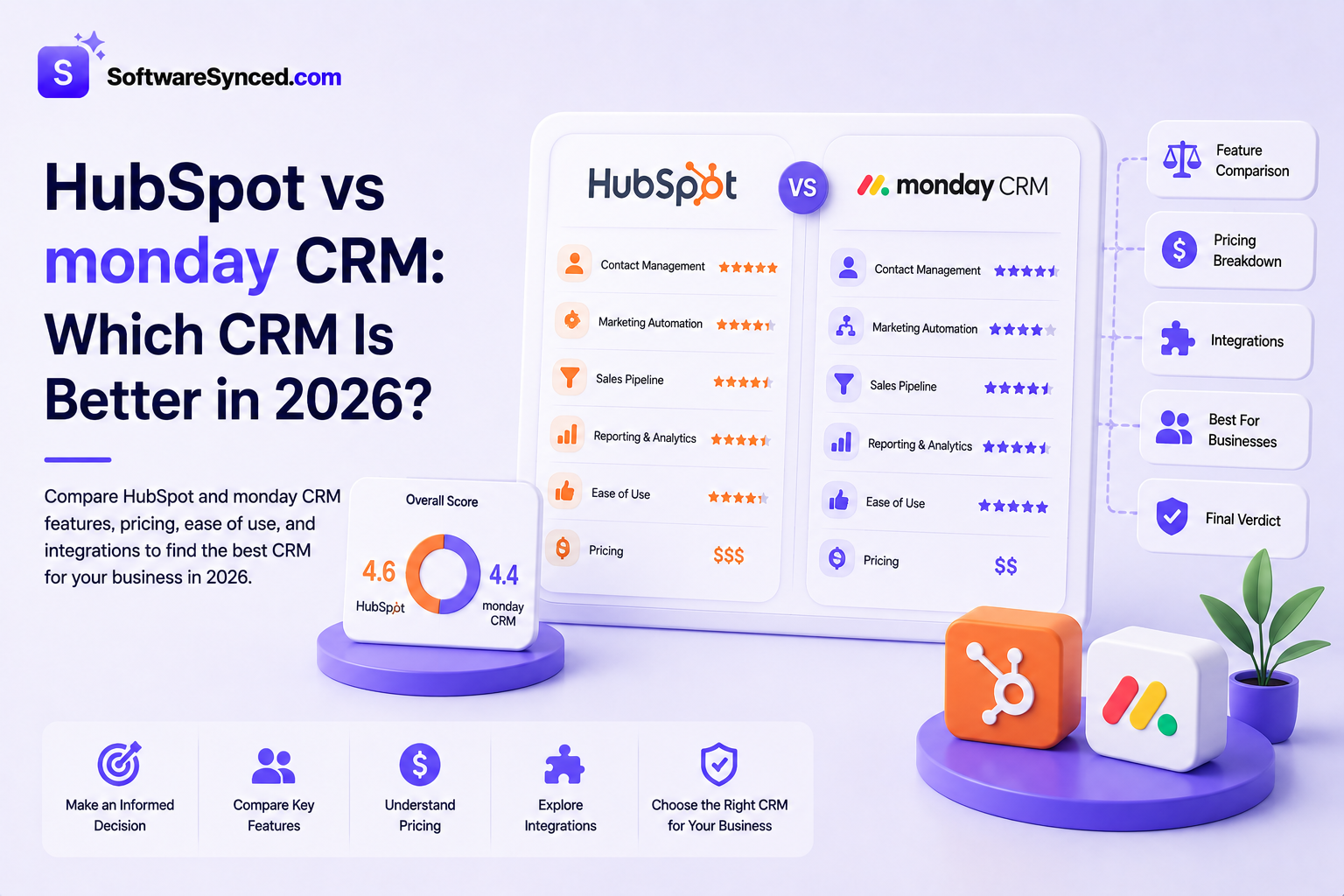
HubSpot and Monday CRM are two of the most frequently compared CRM platforms — but they are built from fundamentally different starting points. HubSpot built a CRM first and layered marketing, sales, and service on top. Monday.com built a work operating system first and adapted it to include CRM features. That architectural difference drives almost every meaningful comparison between the two.
In 2026, both platforms have matured considerably. Monday CRM added email sequences, AI-assisted automation, and more sophisticated reporting. HubSpot deepened its Breeze AI integration across all Hubs and continued its push into enterprise. But the core distinction remains: HubSpot is a revenue platform organised around the customer. Monday CRM is a flexible visual tool organised around boards and workflows.
If you are evaluating these platforms as part of a broader CRM search, our guide to the best CRM software in 2026 covers both alongside Pipedrive, Zoho, Salesforce, and five other options. And if email marketing integration is a priority alongside your CRM, our guide to the best AI email marketing tools in 2026 covers the platforms that sit alongside or overlap with CRM.
How We Evaluated These Tools
Both platforms were assessed the same way: by comparing pricing structures in detail, testing core CRM capabilities, and cross-checking figures published directly on each provider’s website. Here’s what we looked at:
- Pricing structure: advertised cost versus real cost — including seat minimums, bucket pricing, mandatory onboarding fees, and the total spend when required add-ons are factored in
- Pipeline and sales features: deal management depth, email sequences, lead scoring, forecasting, and what is genuinely available on entry plans versus locked behind upgrades
- AI & automation capabilities: how intelligently each platform handles deal coaching, workflow automation, and AI-assisted selling in practice
- Marketing integration: whether email marketing, lead capture, and campaign attribution are native or require separate tools and integration overhead
- Ease of use: how intuitive the interface is for sales reps and administrators, and the realistic adoption rate based on verified user feedback
- Customer support tools: whether helpdesk, ticketing, and service features are native to the platform or require a separate product
- Independent user feedback: ratings and reviews from verified users on G2, Capterra, and TrustRadius
TL;DR: HubSpot vs Monday CRM
HubSpot is the stronger CRM for revenue-focused teams — the free tier is the most functional available, and native marketing, sales, and service tools in one platform reduce the total stack cost. Monday CRM wins for teams already in the Monday ecosystem, visual pipeline clarity, and agencies where deals flow into project delivery. Account for bucket seat pricing and the Pro plan requirement before finalising your Monday cost estimate.
Quick Comparison
| Feature | HubSpot | Monday CRM |
|---|---|---|
| Free Plan | ✅ Yes (unlimited users, 1M contacts) | ✅ Yes (2 seats, basic boards only) |
| Entry Paid Price | $15/user/month (Starter) | $12/seat/month (Basic, 3-seat minimum) |
| Minimum Monthly Spend | $15/month | $36/month (3-seat minimum) |
| Functional Starting Price | $15/user/month | ~$28/user/month (Pro, for sequences) |
| Professional Tier | ~$890/month base (5 users) | $28/seat/month |
| Mandatory Onboarding Fee | ✅ Yes (Professional: ~$3,000) | ❌ No |
| Native Email Marketing | ✅ Yes (Marketing Hub) | ❌ No (requires integration) |
| Email Sequences | ✅ Yes (Sales Hub Starter+) | ✅ Yes (Pro plan only, added 2026) |
| Lead Scoring | ✅ Yes | ❌ No native scoring |
| Revenue Forecasting | ✅ Yes (Professional+) | ✅ Yes (Pro+) |
| Native Customer Support Tools | ✅ Yes (Service Hub) | ❌ No |
| AI Features | ✅ Breeze AI (extensive) | ✅ Limited (task summaries, suggestions) |
| Bucket Seat Pricing | ❌ No | ✅ Yes (inflates real per-user cost) |
| Capterra Rating | 4.5 | 4.6 |
| Best For | Revenue teams, inbound marketing | Teams already on Monday, visual workflows |
The Core Difference in One Sentence
HubSpot is a purpose-built CRM platform with native marketing, sales, and service tools built around the customer. Monday CRM is a visual work operating system adapted to include CRM features, built around boards and workflows.
That architectural distinction shapes every practical comparison. If you ask both platforms “show me total revenue from inbound-sourced leads who converted in Q3, segmented by industry,” HubSpot answers natively because marketing source, deal value, lifecycle stage, and industry are standard CRM properties. Monday CRM can answer it, but you are building it from board columns and formulas — and the answer can change if someone restructures the underlying boards.
Monday CRM’s flexibility becomes a genuine strength when your workflow does not fit a standard CRM mould: agencies running deals into project delivery boards, service businesses tracking client onboarding alongside active deals, or teams where project management and pipeline management genuinely overlap.
Pricing Comparison
HubSpot
HubSpot’s pricing is hub-based and genuinely confusing — the free CRM is separate from the paid Hubs, and costs compound when you add Marketing Hub, Sales Hub, and Service Hub together.
- Free CRM: Unlimited users, up to 1 million contacts, deal pipeline, contact management, email scheduling. Genuinely functional for basic use.
- Starter: $15/user/month (Sales Hub) — adds email sequences, basic automation, meeting scheduling
- Professional: ~$100/user/month (Sales Hub), but purchased as a base platform starting at ~$890/month for 5 users, plus a mandatory ~$3,000 onboarding fee
- Enterprise: ~$150/user/month base plus platform fees
The most important pricing point to understand: the features most sales teams actually need — sequences, deal automation, forecasting, and advanced reporting — live at the Professional tier. The jump from Starter at $15/user/month to Professional at $890/month base is the single biggest pricing cliff in the CRM market.
The hidden cost advantage HubSpot has that Monday does not: Marketing Hub, when bundled, covers email marketing, ad management, landing pages, and lead tracking natively — tools that Monday CRM users typically need to buy separately through Mailchimp, ActiveCampaign, or similar.
Monday CRM
Monday CRM’s pricing appears straightforward but contains two traps worth knowing before committing.
- Free: 2 seats, basic contact boards only — not a functional CRM
- Basic: $12/seat/month (3-seat minimum, $36/month floor) — core pipeline management, no automations
- Standard: $17/seat/month — advanced integrations, basic automations
- Pro: $28/seat/month — email sequences (added 2026), advanced reporting, forecasting
- Enterprise: Custom pricing
Trap 1: The 3-seat minimum. A solo operator or 2-person team pays for 3 seats regardless, making the true entry cost $36/month rather than $12/month.
Trap 2: Bucket seat pricing. Monday CRM sells seats in buckets — 3, 5, 10, 15, 20, 25, and so on. A 7-person team must purchase 10 seats. That inflates real per-user cost by up to 43%. Most comparisons miss this, but it shapes the real economics at team sizes of 6–9, 11–14, and 16–19 people.
Trap 3: Pro is the functional starting point. The Basic plan at $12/seat/month has no automations. The Standard plan has limited automations. For the email sequences and automation most teams expect from a CRM, Pro at $28/seat/month is the realistic minimum — nearly identical in price to HubSpot Starter at $15/user/month when bucket pricing is accounted for.
Verdict on Pricing
Monday CRM wins on raw per-seat cost at Standard tier for teams that fit exactly into seat buckets. HubSpot wins on free tier value — the unlimited-user free plan is the most functional free CRM available — and on total stack cost when email marketing, service, and operations tools are bundled into HubSpot’s platform rather than purchased separately alongside Monday CRM.
Pipeline and Sales Features
HubSpot
HubSpot’s sales features are CRM-native — designed specifically for sales motions from the ground up. The deal pipeline is visual and highly configurable, with deal properties, custom stages, and rotation rules available from Starter. Smart Deal Progression (Professional+) uses AI to surface risk, recommend next steps, and flag deals that have gone quiet — pulling from call recordings, email sentiment, buyer engagement signals, and CRM history simultaneously.
Lead scoring is native. Revenue forecasting is native. Deal attribution — tracking which marketing activity actually influenced a closed deal — is native. These are not features you configure from board columns; they are how the platform is designed to work.
HubSpot’s direction in 2026 is deeper Breeze AI integration across all Hubs — meeting prep summaries, predictive deal scoring, and guided rep actions that surface the right information at the right moment in the sales cycle.
Monday CRM
Monday CRM’s pipeline is the best visual board-based deal view in the category. The drag-and-drop kanban interface is fast, intuitive, and easy for sales reps to adopt without training. For teams that need a clear visual view of where deals stand across stages, Monday’s board interface is genuinely excellent.
What Monday CRM added in 2026: email sequences on the Pro plan, AI-assisted automation suggestions, and improved sales reporting. These additions close some gaps that made Monday CRM feel lightweight as a sales tool. What it still does not have natively: lead scoring, deal rotation rules, revenue attribution, and the depth of AI-assisted coaching that HubSpot’s Breeze AI delivers.
Monday CRM’s intelligence is organised around boards and workflows. HubSpot’s is organised around the customer. For teams running structured outbound — sequences targeting specific accounts, deal coaching based on call data, forecasting that accounts for pipeline velocity — HubSpot’s architecture handles this without the manual setup that Monday requires.
Verdict on Sales Features
HubSpot wins on sales feature depth, particularly for structured outbound, AI-assisted coaching, and revenue attribution. Monday CRM wins on visual pipeline clarity and ease of adoption for teams that do not need the full sales motion HubSpot enables.
Marketing Integration
This is the category where the comparison is most clear-cut.
HubSpot
HubSpot’s Marketing Hub is one of the most complete inbound marketing platforms available. Email campaigns, ad management, landing pages, SEO tools, social media scheduling, lead capture forms, and attribution reporting are all native to the platform. For revenue teams where marketing and sales share a single customer data layer, this integration is HubSpot’s most valuable feature — a marketing-qualified lead moves into the sales pipeline with its full engagement history attached, without any sync job or API call required.
Monday CRM
Monday CRM has no native email marketing capability. It has released a dedicated monday marketer product, but it is a separate product with its own pricing rather than an integrated layer within Monday CRM. Teams that need email marketing alongside Monday CRM typically run Mailchimp, ActiveCampaign, or Brevo in parallel, then use Zapier or native integrations to sync contact and engagement data between the tools.
This is not a minor gap — it is a meaningful operational complexity for any business where marketing and sales need a shared view of the customer. The additional tool cost and integration maintenance overhead partially offsets Monday CRM’s lower per-seat pricing.
Verdict on Marketing Integration
HubSpot wins decisively. Native marketing-to-sales integration is HubSpot’s most significant structural advantage over Monday CRM, and the one that most changes total cost calculations when the add-on tools Monday teams need are factored in.
Ease of Use
HubSpot
HubSpot’s free CRM is the most accessible starting point in the market. The interface is clean and modern, onboarding is guided, and the volume of tutorials, documentation, and community resources available — HubSpot Academy alone offers dozens of free certifications — means getting a team functional is faster than on more complex platforms.
The caveat: HubSpot’s breadth of features can feel overwhelming for users who do not need marketing, service, and operations alongside CRM. The platform’s power is inseparable from its complexity at higher tiers. Teams using Sales Hub only, without Marketing Hub, find the interface considerably more focused.
Monday CRM
Monday CRM’s visual board interface has the highest adoption rate among sales reps who are typically resistant to CRM adoption. The drag-and-drop pipeline view is immediately intuitive — you can understand what it is doing without training. For teams coming from spreadsheet-based tracking, Monday CRM’s visual approach is the closest CRM equivalent and the most natural transition.
The limitation: Monday’s flexibility requires configuration. The free-form board approach means you are building the structure of your CRM rather than working within a predefined sales data model. For teams without someone to own that configuration, the flexibility can become a source of inconsistency as different team members structure deals differently.
Verdict on Ease of Use
Monday CRM wins on immediate visual clarity and sales rep adoption. HubSpot wins on structured onboarding and long-term usability once teams grow beyond basic pipeline tracking.
AI Capabilities
HubSpot — Breeze AI
HubSpot’s Breeze AI is the most developed AI layer in the SMB CRM category in 2026. Breeze Copilot — available across all Hubs — drafts emails, summarises deals, suggests follow-up actions, and generates reports from plain-language questions. Breeze Agents handle prospect research, outreach sequences, and customer service queries with human approval before sending.
Smart Deal Progression uses call recordings, email engagement, CRM history, and buyer signals simultaneously to surface risk and recommend next actions — a genuine operational improvement for sales managers reviewing a large pipeline.
Monday CRM — AI Features
Monday CRM’s AI additions in 2026 cover task summaries, automation suggestions, and meeting prep notes. These are useful for work management but narrow compared to HubSpot’s customer-facing AI depth. For prospecting automation, deal coaching, and AI-assisted follow-up — the use cases where AI makes the most material difference in sales outcomes — Monday CRM does not offer an equivalent to Breeze AI’s scope.
Verdict on AI
HubSpot wins clearly. Breeze AI is purpose-built for revenue workflows — deals, customers, campaigns — in a way Monday’s AI, oriented toward work management, cannot currently match.
Customer Support and Service Tools
HubSpot’s Service Hub adds a native helpdesk, ticketing system, chatbot builder, and customer success tools connected to the same CRM data every sales rep uses. A support agent picking up a ticket can see purchase history, past conversations, and deal value without switching platforms.
Monday CRM has no native customer service product. monday Service launched in 2026 but is a separate product at separate pricing rather than an integrated layer within Monday CRM. Teams that need support tools alongside Monday CRM run a separate help desk — Zendesk, Intercom, Freshdesk — with all the integration overhead that entails.
Verdict on Support Tools
HubSpot wins. For businesses where sales and support need a unified customer view, Monday CRM requires a separate help desk platform and integration maintenance that HubSpot avoids.
Integrations
Both platforms have extensive integration ecosystems. HubSpot’s App Marketplace covers over 1,500 native integrations across marketing, sales, and service categories. Monday.com’s integration centre covers similar breadth with particular strength in project management, development tools, and operations software.
The meaningful difference is which integrations are native versus Zapier-dependent. HubSpot’s email marketing, meeting scheduling, call recording, and document management integrations are native at paid tiers. Monday CRM teams frequently use Zapier to connect email marketing, lead enrichment, and sales engagement tools — at $49–299/month for Zapier depending on task volume.
Verdict on Integrations
Draw for most use cases. HubSpot’s native depth reduces Zapier dependency for revenue-specific workflows. Monday’s integration breadth is stronger for operations and project management workflows.
Who Should Choose HubSpot?
- You want a functional free CRM with no seat limit as a genuine starting point
- Marketing and sales need a shared customer data layer without integration overhead
- Your team runs structured outbound — sequences, deal coaching, revenue attribution
- Customer support is part of your operation and you want a unified platform
- AI-assisted selling — deal coaching, predictive scoring, meeting prep — is a priority
- You are prepared for the Professional pricing cliff and have budgeted accordingly
Who Should Choose Monday CRM?
- Your team is already using Monday.com for project management or operations
- Visual pipeline clarity and high sales rep adoption matter more than deep CRM features
- Your sales process is straightforward — pipeline tracking, contact management, basic sequences — without needing native marketing or service tools
- Agencies or service businesses where deals flow directly into project delivery boards
- Budget is the primary constraint and you can manage email marketing through a separate tool
- You need flexible, custom workflows that a standard CRM data model would constrain
Final Verdict
Neither platform is universally better — they serve different architectures and different business types.
Choose HubSpot if revenue is your primary use case and you want marketing, sales, and service in a single platform organised around the customer. The free tier is the most functional free CRM available. The Professional pricing cliff is real and needs to be budgeted carefully — but for teams that need what Professional unlocks, HubSpot’s native depth reduces the external tool cost that Monday CRM teams typically accumulate.
Choose Monday CRM if your team is already embedded in the Monday ecosystem, your sales process is visual and straightforward, or your business genuinely blends project management and deal management in a way that Monday’s board architecture handles better than a purpose-built CRM. Account for bucket seat pricing and the Pro plan requirement for sequences before finalising the cost comparison.
If you are still evaluating the broader CRM landscape, our guide to the best CRM software in 2026 covers both platforms alongside Pipedrive, Zoho, Freshsales, Salesforce, Close, and Streak — with the same honest trade-offs applied to every platform.
Frequently Asked Questions
Is HubSpot actually free? Yes — the free CRM includes unlimited users, up to 1 million contacts, deal pipeline, and basic email tools. The limitations appear when you need sequences, advanced automation, and forecasting, which require paid plans. The jump from Starter ($15/user/month) to Professional (~$890/month base) is the biggest cost cliff to plan for, and Professional includes a mandatory ~$3,000 onboarding fee.
What is Monday CRM’s real starting price? The advertised $12/seat/month (Basic) requires a 3-seat minimum, making the true floor $36/month. For useful CRM functionality — email sequences and automation — the Pro plan at $28/seat/month is the realistic minimum. Bucket seat pricing means a 7-person team buys 10 seats, inflating the real per-user cost by up to 43%.
Which is better for a small team of under 10 people? For teams under 10 that primarily need pipeline management without complex marketing automation, Monday CRM’s Pro plan is price-competitive with HubSpot Starter once bucket seats are accounted for. HubSpot’s free tier is the strongest starting point for teams testing CRM before committing to any paid plan.
Can Monday CRM replace HubSpot for email marketing? No. Monday CRM has no native email marketing capability. Teams running Monday CRM alongside email marketing need a separate platform — Mailchimp, ActiveCampaign, or Brevo — and typically a Zapier connection to sync contact and engagement data. This integration cost partially offsets Monday’s lower per-seat pricing.
Which has better AI in 2026? HubSpot’s Breeze AI is significantly more developed for sales use cases — deal coaching, predictive scoring, meeting prep, and guided rep actions based on call and email data. Monday CRM’s AI covers task summaries and automation suggestions, which are useful for work management but narrower than HubSpot’s customer-facing AI depth.
Is Monday CRM good for agencies? Yes — for agencies where deals flow directly into project delivery boards, Monday CRM’s architecture handles the sales-to-delivery handoff more naturally than a purpose-built CRM. This is the specific use case where Monday’s work OS roots are an advantage rather than a limitation.