
Published: June 9, 2026 | Reading time: 7 minutes
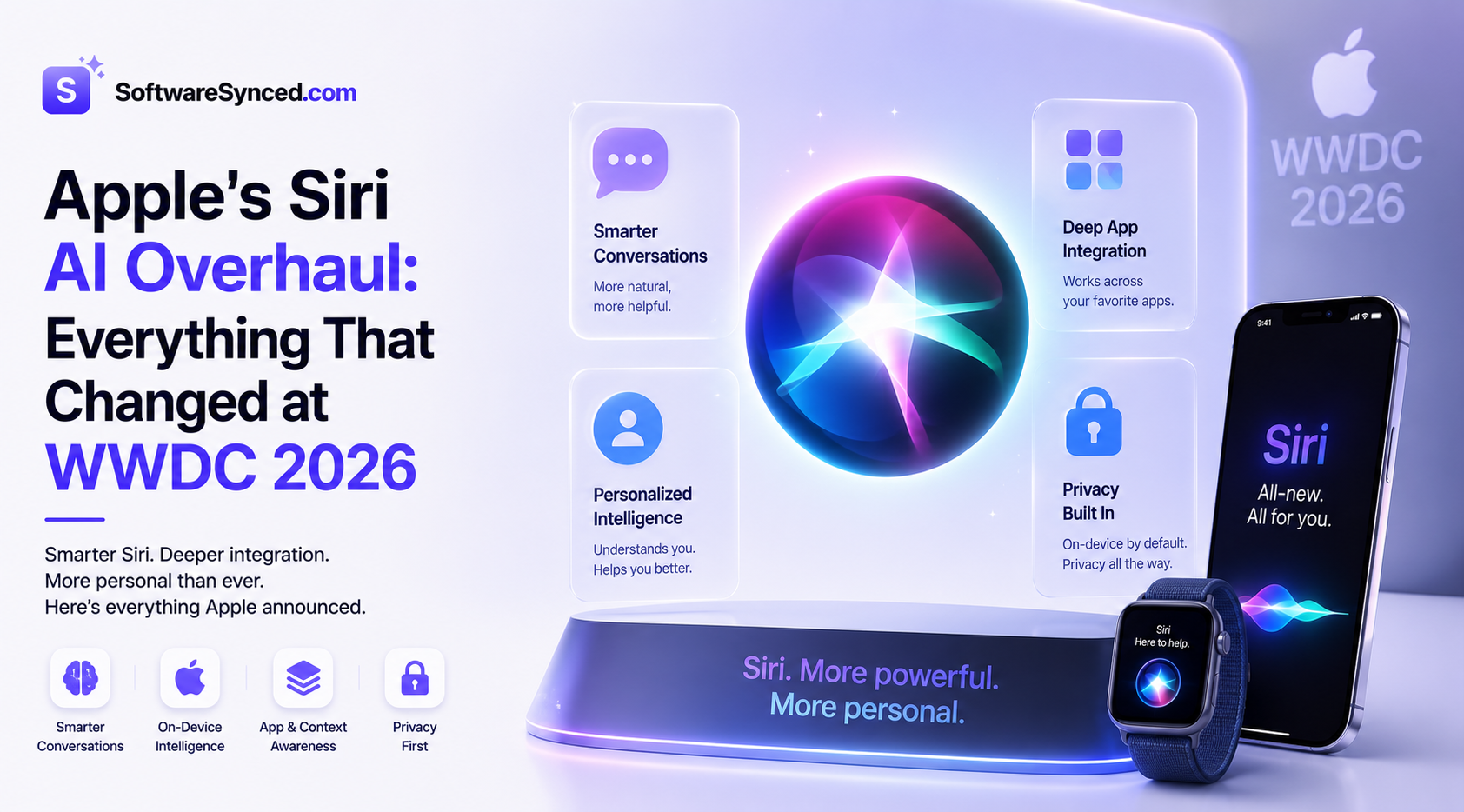
Apple spent years promising a smarter Siri. At WWDC 2026, it finally delivered — or at least made the most convincing case yet that it is heading in the right direction.
The keynote at Apple Park on June 8 was significant for two reasons beyond the announcements themselves. It marked Tim Cook’s final WWDC as CEO, with hardware engineering head John Ternus set to take over on September 1. And it was Apple’s clearest public admission that Siri, as it existed, was not keeping pace with what users now expect from AI assistants.
“We believe privacy in AI is non-negotiable,” Apple Senior Vice President Craig Federighi said during the keynote. The framing was deliberate — positioning Apple’s AI approach as fundamentally different to competitors rather than simply catching up to them.
Here is a clear breakdown of what actually changed, what it means in practice, and what is still missing.
The Core Change: Siri Is Now Powered by Google Gemini
The most significant structural change to Siri is not a feature — it is what is running underneath. Apple confirmed a partnership with Google in January 2026 to bring Gemini’s model capabilities into Apple’s AI infrastructure. The new Siri is built on what Apple calls its next-generation Apple Foundation Models, developed in collaboration with Google’s Gemini family.
What this means practically: Siri is now considerably more capable at understanding context, handling multi-step instructions, and generating responses that feel like a capable AI assistant rather than a voice command parser. The gap between what Siri could do and what ChatGPT, Claude, and Gemini could do natively has been the central criticism of Apple’s AI efforts since 2023. This is Apple’s answer to that criticism.
The privacy architecture around this is worth understanding. Apple was emphatic at the keynote that Gemini processing happens within Apple’s Private Cloud Compute infrastructure — data is used only to execute your request and is not retained. Craig Federighi stated directly that outside experts can verify this at any time, a claim no other major AI platform makes about its cloud processing.
What Siri Can Actually Do Now
Multi-Step Commands in a Single Prompt
The old Siri required breaking complex tasks into separate requests. The new Siri handles chained instructions in a single prompt. Apple demonstrated a real-world example: looking up the FIFA 2026 World Cup schedule, asking Siri to help plan a party around a specific match, and requesting dish recommendations from both competing countries — all in one continuous conversation.
This is table stakes for ChatGPT and Gemini users in 2026, but it is a genuinely meaningful change for Siri, which has historically struggled with anything more complex than single-step voice commands.
A Standalone Siri App
Siri now exists as a standalone app — a significant structural change. Previously, Siri was a system overlay with no persistent context. The new Siri app maintains conversation history, syncs your chats across iPhone, iPad, Mac, Vision Pro, and Apple Watch, and allows you to continue a conversation on a different device without losing context.
In visionOS 27, the Siri app is represented as a movable orb you can place anywhere in your spatial environment.
On-Screen and Cross-App Awareness
The new Siri understands what is currently on your screen and can take action across apps based on that context. The demo showed selecting three presentations and asking Siri to compare them and recommend one — Siri pulling context from the actual documents rather than requiring manual input.
The Phone app now pulls context from Mail and Messages during calls, surfacing relevant information mid-conversation. This cross-app awareness is the feature most enterprise users have been waiting for — an AI assistant that knows what you are actually working on rather than operating in a vacuum.
A New “Search or Ask” Panel in iOS 27
Swiping down from the top centre of the screen in iOS 27 launches a new Search or Ask panel. From this single entry point you can run system shortcuts, search your device, ask Siri directly, or hand off complex queries to third-party AI providers — ChatGPT, Claude, or Gemini — without leaving the system experience. The panel makes AI access genuinely frictionless for the first time on iPhone.
Apple Intelligence Updates Beyond Siri
The Siri overhaul was the headline, but Apple Intelligence updates across the operating system are equally significant for day-to-day use.
Messages — AI-powered reply suggestions now appear in the Messages app, drawing on conversation context to generate relevant response options rather than generic prompts.
Safari — tab management now includes AI-powered organisation, grouping open tabs by topic automatically. This is one of the most immediately useful features for heavy browser users.
Passwords — one-tap password updating across apps and websites. If a service prompts you to change your password, Apple Intelligence handles the update automatically without requiring you to copy, paste, and navigate through settings. This works alongside existing password manager integrations — if you are using a dedicated tool like Bitwarden or 1Password, both continue to work alongside the system.
Visual Intelligence — now integrated into the Wallet app. Point your camera at a bill, receipt, or menu and Visual Intelligence extracts the relevant information directly. The Camera app also gets a dedicated Siri mode alongside Photo, Video, Portrait, and Panorama, using Google Image Search to accurately identify objects in frame.
iOS 27: The Broader Update
The Siri AI changes arrive as part of iOS 27, which Apple positioned as a “deep clean” release focused on performance and stability alongside the AI additions.
Specific claims Apple made during the keynote:
- New photos load 70% more quickly
- AirDrop transfers are 80% faster
- CPU scheduler improvements for better multitasking performance
iOS 27 will be available on all devices from the iPhone 11 onward — Apple stated this will make it available to more users than any iOS release in the company’s history. The Liquid Glass design introduced in iOS 26 is staying, but a new system-wide slider gives users more control over how pronounced the effect is — a direct response to the vocal criticism the design received after its 2025 introduction.
macOS 27, named Golden Gate, arrives alongside iOS 27 in Fall 2026, bringing the same Siri AI features and Apple Intelligence updates to Mac.
The EU Problem: Siri AI Will Not Launch in Europe
The announcement most European iPhone users need to know: Siri AI will not be available in the EU at launch.
Apple confirmed at the keynote that the Digital Markets Act prevented it from shipping Siri AI in the European Union with the initial iOS 27 and iPadOS 27 release. EU regulators rejected every solution Apple proposed for bringing Siri AI to the region while simultaneously supporting other virtual assistants as required by the DMA.
The statement from Apple: “Unfortunately, due to the Digital Markets Act (DMA), Apple will not be able to ship Siri AI in the European Union with the release of iOS 27 and iPadOS 27.”
No timeline was provided for EU availability. This is a significant gap — EU users will receive iOS 27’s performance improvements and design updates but not the AI features that define this release. It continues a pattern of DMA compliance conflicts reducing the feature set available to European users of Apple products.
The Honest Assessment
Apple’s Siri overhaul is real and meaningful. Multi-step commands, cross-app context awareness, conversation persistence, and the Gemini-powered foundation model are genuine improvements that close the gap between Siri and competitors that have been ahead for two to three years.
The timing is also honest to acknowledge: most of what Apple announced at WWDC 2026 has been table stakes on ChatGPT, Claude, and Gemini for a while. Apple’s advantage is privacy architecture, hardware integration, and a user base that has been waiting for a reason to use Siri rather than switching to a third-party app for AI tasks.
Whether Siri AI actually changes how people interact with their iPhones day-to-day depends on execution — demos at WWDC 2026 looked strong, but WWDC demos have looked strong before. iOS 27 arrives in Fall 2026 alongside iPhone 17. That is when the real assessment begins.
iOS 27 and macOS 27 Golden Gate are expected to release publicly in Fall 2026, alongside the iPhone 17 lineup. Developer betas are available now for registered Apple developers.