
Last updated: May 2026 | Reading time: 8 minutes
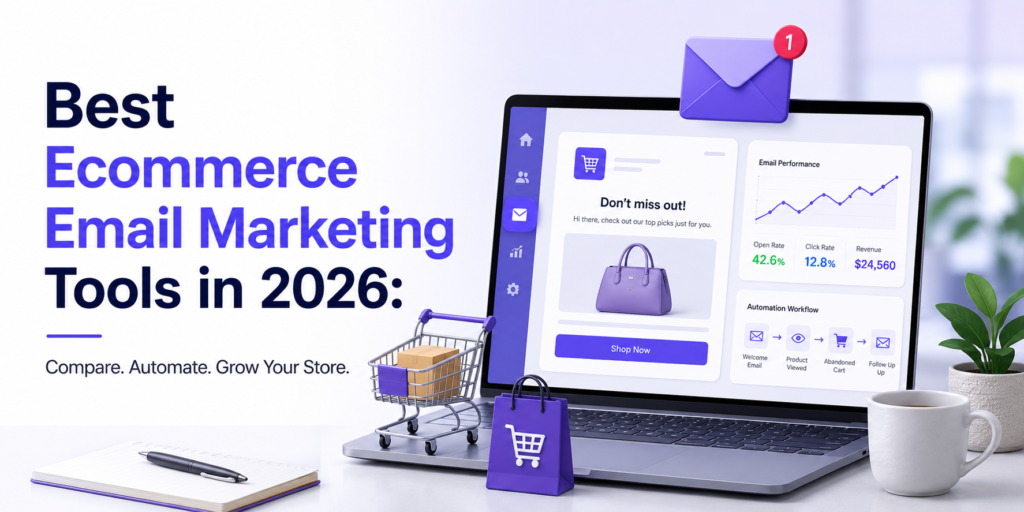
This guide reviews the best ecommerce marketing tools available in 2026, covering pricing, strengths, weaknesses, and who each tool is best suited for. No affiliate spin — just honest takes.
Quick Comparison
| Tool | Free Plan | Starting Price | Best For |
|---|---|---|---|
| Klaviyo | Yes (250 contacts) | ~$20/month | Advanced Shopify stores |
| Omnisend | Yes (500 emails/mo) | ~$16/month | Budget multichannel ecom |
| ActiveCampaign | No | ~$15/month | Automation-heavy businesses |
| Brevo | Yes (300 emails/day) | ~$9/month | Budget multichannel + SMS |
| Drip | No (14-day trial) | ~$39/month | Data-driven DTC brands |
What Makes an Email Tool “Ecommerce-Ready”?
Before diving in, here’s what separates a true ecommerce email platform from a generic one:
- Native integrations with Shopify, WooCommerce, or BigCommerce (not just Zapier workarounds)
- Automated flows for abandoned cart, browse abandonment, post-purchase, and back-in-stock
- Revenue attribution — tracking which emails actually drove sales
- Product data sync — real-time pulling of product names, images, and prices into emails
- Segmentation based on purchase history and customer lifetime value
With that in mind, here are the top tools worth your attention.
1. Klaviyo — Best for Serious Ecommerce Stores
Pricing: Free up to 250 contacts. Paid plans start at ~$20/month for 500 contacts. Gets expensive fast at scale.
Best for: Mid-to-large Shopify stores that want deep data and automation power.
Klaviyo is widely considered the gold standard for ecommerce email marketing. Its Shopify integration is one of the deepest available — pulling in purchase history, browse behaviour, product data, and predictive lifetime value in real time. This enables precise customer segments and automation triggers that generic platforms simply cannot replicate.
What’s genuinely great:
- Predictive analytics (forecasts when customers are likely to churn or buy again)
- Revenue attribution tied to specific emails and flows
- Pre-built automation templates for every ecommerce scenario
- SMS and email in one platform
Honest downsides:
- Pricing scales steeply. Mailchimp and Klaviyo both become expensive quickly as your list grows — calculate what you’d pay at 3x your current list size before committing
- The interface has a learning curve; it is not beginner-friendly
- Overkill for small stores just getting started
Verdict: If you’re serious about ecommerce and can afford it, Klaviyo is hard to beat. If you’re just starting out or on a tight budget, start elsewhere. You can always find Klaviyo alternative list, and compare it to other brands.
2. Omnisend — Best for Budget-Conscious Multichannel Selling
Pricing: Free plan available (500 emails/month, 250 contacts). Paid plans from ~$16/month.
Best for: Small to mid-size ecommerce stores, especially Shopify users who want email + SMS without breaking the bank.
Omnisend has rapidly matured into one of the most capable ecommerce-specific platforms on the market. It has quick and easy integration with all major ecommerce platforms and is packed with advanced tools designed specifically for online retailers. Since early 2025 alone, Omnisend has released over 60 new features — the platform is evolving fast.
What’s genuinely great:
- Generous free plan that includes 24/7 live chat support — rare at the free tier
- Pre-built ecommerce automations (abandoned cart, welcome series, post-purchase) are ready to go out of the box
- Email and SMS combined in one dashboard at an affordable price
- Clean, intuitive interface — beginner-friendly
Honest downsides:
- Without an ecommerce store connected, you lose most of what makes it special — not ideal if you also run non-ecommerce campaigns
- Reporting is good but not as granular as Klaviyo
- Some advanced segmentation features are locked behind higher plans
Verdict: One of the best value options for ecommerce stores in 2026. A strong first choice if you’re on a budget and want a platform that grows with you.
3. ActiveCampaign — Best for Automation-Heavy Businesses
Pricing: No free plan. Paid plans from ~$15/month (Lite). Ecommerce features require higher tiers.
Best for: Businesses that need deep marketing automation beyond just email — especially those blending ecommerce with content, services, or SaaS.
ActiveCampaign has consistently ranked as one of the top overall email marketing platforms for years, largely thanks to its visual workflow builder and consistently strong deliverability. Its AI-powered features (branded as Active Intelligence) help automate complex customer journeys that most tools cannot handle natively.
What’s genuinely great:
- Best-in-class visual automation builder — highly flexible and powerful
- CRM built in, which is useful if you manage customer relationships beyond just purchases
- Strong deliverability track record across many years of independent testing
- Works well for hybrid businesses (selling both products and services)
Honest downsides:
- No free plan is a real barrier for those just starting out
- Ecommerce-specific features (product blocks, revenue tracking) are not as polished as Klaviyo or Omnisend
- Can feel overwhelming due to the sheer number of features
- Pricing climbs quickly if you need ecommerce + CRM features together
Verdict: Excellent if your business straddles ecommerce and services, or if deep automation is your priority. For pure ecommerce stores, Klaviyo or Omnisend are more purpose-built.
4. Brevo (formerly Sendinblue) — Best Free Option for Multichannel Marketing
Pricing: Free plan with unlimited contacts and 300 emails/day. Paid plans from ~$9/month.
Best for: Budget-conscious stores that also want SMS, WhatsApp, and email all in one place without upgrading tiers.
Brevo stands out for one key reason: email and SMS are available on all plans, including the free tier. Most platforms charge extra for SMS or lock it behind higher tiers. For small ecommerce stores managing multiple channels on a tight budget, this is a genuine differentiator.
What’s genuinely great:
- Unlimited contacts even on the free plan (you pay based on emails sent, not list size)
- SMS included on all plans — no add-on fees
- Scales more predictably than many competitors as your list grows
- Solid transactional email features (order confirmations, shipping updates)
Honest downsides:
- Ecommerce-specific automation flows are not as deep as Klaviyo or Omnisend
- The template builder, while functional, is less polished than competitors
- Revenue attribution and product data sync are more limited
- The free plan’s 300 emails/day limit becomes restrictive quickly for active stores
Verdict: A smart choice if you’re starting out, keeping costs low, or want multichannel marketing without paying premium prices. Not the best choice if advanced ecommerce automation is your top priority.
5. Drip — Best for Data-Driven DTC Brands
Pricing: Starts at $39/month for up to 2,500 contacts. No free plan, but a 14-day free trial is available.
Best for: Direct-to-consumer (DTC) brands that want ecommerce-specific features with a focus on customer data and personalisation.
Drip positions itself squarely at ecommerce brands and does not try to be everything to everyone. It sits alongside Klaviyo and Omnisend as one of the dedicated ecommerce email leaders, with strong Shopify and WooCommerce integrations and a focus on turning customer data into personalised campaigns.
What’s genuinely great:
- Clean, focused interface designed specifically for ecommerce
- Strong customer data platform — tags, custom fields, and event tracking are all robust
- Solid pre-built workflows for ecommerce scenarios
- Good revenue reporting tied directly to email performance
Honest downsides:
- Pricing is higher than Omnisend or Brevo at smaller list sizes — harder to justify for new stores
- No free plan means you need to commit financially before you know if it suits you
- Smaller user community compared to Klaviyo, meaning fewer third-party resources and tutorials
- SMS features are more limited compared to Omnisend or Brevo
Verdict: A solid Klaviyo alternative for DTC brands, particularly if you find Klaviyo’s pricing too steep or its interface too overwhelming. Best suited for stores already generating consistent revenue.
Which Tool Should You Choose?
- Just starting out with a small budget? Start with Omnisend or Brevo — both have strong free plans and room to grow.
- Running a serious Shopify store and want the best data? Go with Klaviyo.
- Selling both products and services? ActiveCampaign handles the complexity better than most.
- DTC brand ready to invest in a focused ecommerce platform? Consider Drip.
One important note before you decide: always calculate what you’d pay at three times your current list size. Platforms that look affordable at 500 contacts can become expensive at 10,000 or 50,000 — and migrating later is a real headache.
Final Thoughts
There is no single “best” ecommerce email marketing tool — the right choice depends on your store size, budget, technical comfort, and which ecommerce platform you’re running. What matters most is picking a tool with native ecommerce integrations, proper automation capabilities, and a pricing model that makes sense for where you are now and where you’re heading.
All five tools reviewed here are legitimate, actively maintained platforms worth considering in 2026. Start with a free plan or trial, test your most critical flows (abandoned cart at minimum), and upgrade when the revenue justifies it.