
Last updated: August 2026 | Reading time: 10 minutes
Product features, pricing, and factual claims were reviewed against official sources. We update this article as information changes.
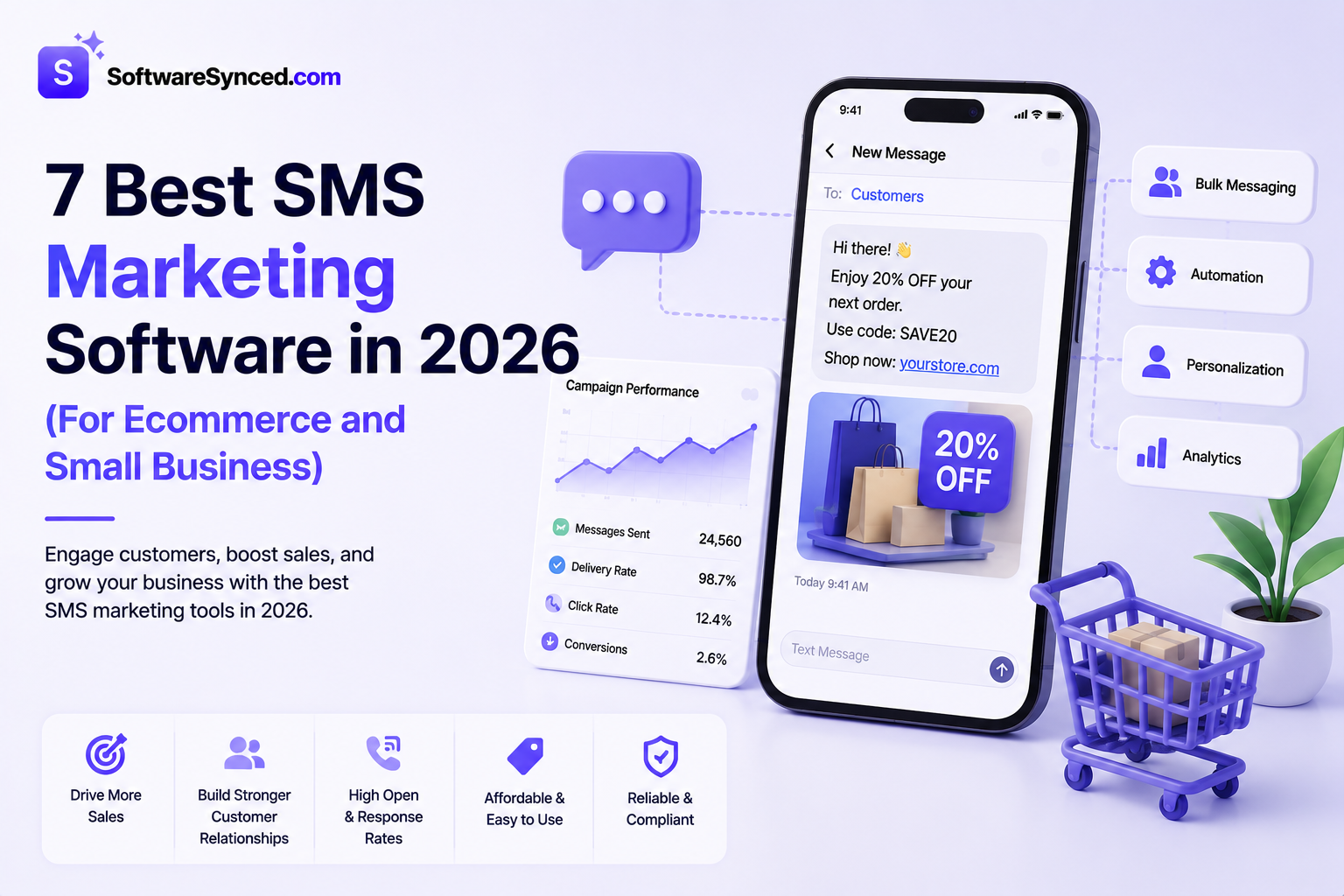
SMS marketing has the highest open rate of any marketing channel, consistently above 90%.
Moreover, the average SMS is read within three minutes of delivery.
For time-sensitive campaigns such as flash sales or back-in-stock alerts, Best SMS Marketing Software delivers unmatched immediacy.
The challenge in 2026 is that Best SMS Marketing Software covers a wide spectrum. For instance, dedicated SMS-first platforms built entirely around text messaging. Alternatively, email marketing platforms have added SMS as a channel alongside their core product. The right choice depends on whether SMS is your primary channel or part of a broader multichannel stack.
“AI email marketing” spans a huge range — from basic subject-line suggestions to platforms that predict individual customer behavior. The right pick depends on your business type, not which tool has the longest AI feature list:
- B2B or CRM-driven marketing? ActiveCampaign for automation depth, HubSpot if you’re already in its CRM.
- Large list, tight budget? Brevo — bills by send volume, not contacts.
- Just starting out? Mailchimp for beginners, MailerLite for creators and newsletters.
- Mid-size ecommerce? Drip, for revenue attribution and churn prediction.
- High-volume ecommerce? Klaviyo has the deepest individual-level predictive AI.
- Ecommerce with SMS and web push? Omnisend — though see the fact-check note on SMS pricing below.
- Ecommerce on the smallest budget? Moosend, from $9/month.
7 SMS Marketing Platforms in 2026
This guide covers seven SMS marketing platforms that genuinely stand out in 2026. Specifically, it explains what each does well, where it falls short, and which type of business it is built for.
If you evaluate these platforms as part of ecommerce marketing, our guide to tools in 2026 covers the full picture. Moreover, our ecommerce email marketing guide explains how SMS and email work best together.
TL;DR: Best SMS Marketing Software at a Glance
| Best Tool | Use Case | Key Differentiator |
|---|---|---|
| Klaviyo | Ecommerce SMS + email in one platform | Shared data layer with email for unified flows and predictive analytics |
| Omnisend | Multichannel ecommerce marketing | SMS included in plan pricing with email and web push |
| Attentive | Enterprise SMS-first brands | RCS support, conversational AI, and the strongest subscriber growth tools |
| Postscript | Shopify-only SMS | Pay-per-SMS with no monthly fee and quick Shopify setup |
| Brevo | Budget multichannel including SMS | Unlimited contacts, volume-based pricing, 180+ country SMS reach |
| SimpleTexting | Non-ecommerce SMS campaigns | Purpose-built for local services, healthcare, and organisations |
| SMSBump (Yotpo) | Shopify + loyalty integration | SMS flows triggered natively by Yotpo loyalty and review events |
Quick Comparison
| Platform | Best For | Free Plan | Starting Price | SMS Channel | Email Included |
|---|---|---|---|---|---|
| Klaviyo | Ecommerce stores needing SMS + email | ✅ Yes (250 contacts) | ~$20/month + SMS credits | ✅ Yes | ✅ Yes |
| Omnisend | Ecommerce multichannel marketing | ✅ Yes (500 emails/mo) | ~$16/month | ✅ Yes (included) | ✅ Yes |
| Attentive | SMS-first enterprise ecommerce | ❌ No | Custom pricing | ✅ Yes (specialist) | ✅ Yes |
| Postscript | Shopify-only SMS | ❌ No (free trial) | Pay-per-SMS | ✅ Yes | ❌ No |
| Brevo | Budget multichannel | ✅ Yes | ~$9/month | ✅ Yes | ✅ Yes |
| SimpleTexting | Non-ecommerce SMS campaigns | ✅ Yes (14-day trial) | ~$35/month | ✅ Yes | ❌ No |
| SMSBump (Yotpo) | Shopify SMS with loyalty integration | ❌ No (free starter) | Pay-per-SMS | ✅ Yes | ❌ No |
What to Look for in Best SMS Marketing Software
Before comparing platforms, it helps to know which factors actually drive results.
However, most SMS tools market themselves on the same list of features for Best SMS Marketing Software.
Compliance and deliverability are essential to SMS campaigns. In the US, TCPA compliance; in the EU, GDPR; and carrier regulations are non-negotiable. Moreover, a platform that helps you collect opt-ins, manage consent records, and handle opt-outs automatically supports Best SMS Marketing Software. It also reduces legal risk. Deliverability infrastructure varies; platforms with dedicated short codes and established carrier relationships outperform those on shared infrastructure.
Integration depth with your store is essential for Best SMS Marketing Software.
Moreover, an SMS platform that pulls purchase data, cart events, and browse behavior from your store enables revenue automation.
Additionally, a platform that only sends broadcast campaigns without store data integration is significantly less valuable.
Pricing model transparency.
Additionally, for Best SMS Marketing Software, pricing varies by per-message credits, monthly plans, or pay-as-you-go.
Some platforms (like Klaviyo) layer SMS credits on top of their email plan in ways that are harder to predict.
Knowing the real per-message cost at your expected volume is the most important pricing question before committing.
Two-way messaging has become standard for customer service. Broadcast-only SMS remains a one-way channel. Two-way messaging, where subscribers can reply and the platform handles responses, is growing for conversational SMS flows. For Best SMS Marketing Software, these options support effective two-way engagement.
Klaviyo — Best SMS Marketing Software for Ecommerce SMS and Email Integration
A free plan is available for up to 250 contacts.
Additionally, the starting price is approximately $20 per month plus SMS credits.
Furthermore, this is best for ecommerce stores using Klaviyo for email who want to add SMS in the same platform.
Klaviyo’s SMS offering is the natural choice for many Shopify and WooCommerce stores already using Klaviyo for email.
Moreover, Best SMS Marketing Software keeps both channels on one platform, not two, sharing profiles, segmentation, and flow builder.
The integration depth is the key advantage for Best SMS Marketing Software. Additionally, Klaviyo’s SMS and email share the same data layer, including purchase history and customer lifetime value. Your SMS automation can be as sophisticated as email flows. An abandoned cart SMS triggered by real cart data is followed by an email. If no action is taken, these messages run in a single, coordinated flow. That coordination makes Klaviyo’s SMS noticeably more powerful than standalone tools.
In 2026, key features emerge for Best SMS Marketing Software.
Additionally, they include automation, analytics, and scalable messaging.
Unified flow builder — build automation that combine email and SMS in a single workflow. Additionally, it includes branching logic that sends SMS when email is not opened, or vice versa. Best SMS Marketing Software ties the channels together for consistent customer journeys.
Additionally, AI-powered send time optimization applies to SMS as well as email in Best SMS Marketing Software.
Klaviyo’s predictive send time delivers messages at the window when each subscriber is most likely to engage.
As Best SMS Marketing Software, Conversational SMS is two-way messaging for customer service and post-purchase engagement.
Additionally, it is managed alongside your marketing flows in the same dashboard.
The honest trade-off: Klaviyo’s SMS pricing model is one of the hardest to predict.
Moreover, it uses credits tied to the wider plan setup, not a simple standalone SMS bill.
International SMS coverage is limited; MMS is only available for US numbers, Canadian toll-free numbers, and Australian long codes.
For brands that need global SMS reach, Best SMS Marketing Software may offer a better fit.
Our Mailchimp vs Klaviyo comparison and Klaviyo alternatives guide cover the broader Klaviyo platform in detail if you are still evaluating whether it is the right fit overall.
Best SMS Marketing Software for ecommerce stores already on Klaviyo for email. Additionally, they want to add SMS without introducing a second platform.
However, not ideal for brands needing transparent, predictable SMS pricing or wide international coverage. Klaviyo’s credit model and geographic limitations are real constraints for Best SMS Marketing Software at scale.
2. Omnisend — Best SMS Marketing Software for Multichannel Ecommerce Marketing
Free plan: Yes (500 emails/month). Additionally, the starting price is about $16/month. Best for ecommerce stores seeking Best SMS Marketing Software, with email, SMS, and web push at price lower than Klaviyo.
Omnisend is the strongest all-in-one multichannel marketing platform for ecommerce stores.
Additionally, it includes SMS in standard pricing, not as a paid add-on, and is favored as Best SMS Marketing Software.
The SMS functionality covers the full ecommerce automation set.
It includes abandoned cart, post-purchase, back-in-stock, browse abandonment, and a welcome series.
All are configurable to trigger SMS alone, email alone, or both in a coordinated sequence.
Moreover, Best SMS Marketing Software like Omnisend has broader global reach than Klaviyo.
Additionally, key features in 2026 include improvements to Best SMS Marketing Software and expanded automation capabilities.
Best SMS Marketing Software enables SMS and email to run in unified flows. Additionally, build multichannel automation that combine SMS, email, and web push. Each channel triggers based on subscriber behavior in a single drag-and-drop flow builder.
Additionally, pre-built ecommerce automation templates support abandoned cart, welcome series, and post-purchase flows.
Moreover, they include SMS steps already configured, ready to activate in minutes for Best SMS Marketing Software.
Additionally, TCPA and GDPR compliance tools, built-in consent management, double opt-in for SMS, and automatic opt-out handling, support Best SMS Marketing Software.
Best SMS Marketing Software offers 24/7 live chat support on all plans, including free.
Additionally, it is one of the few platforms where meaningful support is accessible without a premium plan.
The honest trade-off: Omnisend’s SMS analytics are less granular than Attentive’s. Its AI features are less sophisticated than Klaviyo’s predictive layer for large, complex datasets. For stores at significant scale, per-message optimization matters; the specialist platforms may deliver marginal improvements. In most small to mid-size ecommerce stores, Omnisend’s feature set is more than sufficient. When comparing Best SMS Marketing Software, these trade-offs vary by scale.
Additionally, we cover Omnisend in depth in our ActiveCampaign vs Omnisend comparison, highlighting Best SMS Marketing Software options.
Best SMS Marketing Software is ideal for mid-size ecommerce stores wanting SMS, email, and web push in one platform.
Additionally, SMS is included in plan pricing rather than charged separately.
This is not ideal for enterprise stores at significant SMS volume. Therefore, specialist analytics and deliverability optimization justify a dedicated SMS platform for Best SMS Marketing Software.
3. Attentive — Best SMS Marketing Software for Enterprise Ecommerce
Free plan: No | Starting price: Custom pricing (contact sales) | Best for: Mid-to-large ecommerce brands where SMS is a primary revenue channel
Attentive is the market-leading dedicated SMS platform for ecommerce and the benchmark against which other SMS tools are measured on specialist features. Attentive is best for SMS-first brands with large text lists that want two-way conversational texting, and it excels in SMS marketing with RCS capabilities.
RCS (Rich Communication Services) is the most significant 2026 differentiator — Attentive’s RCS support allows SMS messages to include images, videos, carousels, and branded sender names where the recipient’s device and carrier supports it, producing a significantly richer experience than standard SMS. For brands whose SMS strategy goes beyond plain-text notifications, RCS capability is a real competitive advantage.
Key features in 2026:
Two-way conversational SMS — Attentive’s AI Journeys handles inbound subscriber replies intelligently, routing to automation or human agents as appropriate, enabling genuine SMS-based customer service at scale.
Attentive Sign-Up Units — industry-leading subscriber growth tools with two-tap mobile opt-in, timed overlays, and placement across web, email, and in-store touchpoints. Subscriber acquisition is often cited as Attentive’s strongest differentiator — brands using Attentive’s growth tools consistently report higher opt-in rates than competitors.
Advanced segmentation and personalisation — behavioral, transactional, and predictive segmentation at a depth comparable to Klaviyo’s email segmentation, applied specifically to SMS flows.
The honest trade-off: Attentive’s pricing is premium, primarily based on SMS volume, making it suitable for brands with substantial SMS marketing budgets. Custom pricing with no transparent published rates means evaluating total cost requires a sales conversation. Pricing for Attentive can escalate significantly as your contact list grows, so understanding total cost of ownership is crucial before choosing the platform. For smaller stores, Omnisend or Klaviyo’s SMS features deliver comparable everyday functionality at a fraction of the cost.
Best for: Mid-to-large ecommerce brands where SMS is a primary revenue channel, subscriber growth is a priority, and the budget supports a dedicated specialist platform.
Not ideal for: Small businesses or stores where SMS is a secondary channel — the pricing model and sales-led procurement process are not designed for small-scale use cases.
4. Postscript — Best for Shopify-Only SMS
Free plan: No (14-day free trial) | Starting price: Pay-per-SMS | Best for: Small Shopify stores wanting quick, simple SMS setup focused purely on text marketing
Postscript is ideal for small Shopify-only stores prioritizing SMS marketing. Its pay-per-message pricing and SMS-focused feature set are practical for companies wanting quick deployment and strong compliance without added platform complexity.
Postscript’s defining characteristic is its Shopify exclusivity — it integrates with Shopify and only Shopify, which means the integration is deep and the setup is fast. Postscript pulls Shopify purchase data, cart events, and customer profiles natively without configuration, and its compliance tools are specifically built around US SMS regulations with Shopify merchant workflows in mind.
Key features in 2026:
Pay-per-SMS pricing with no monthly fee — you pay only for messages sent, with no base subscription cost. For stores with lower SMS volumes or inconsistent sending schedules, this avoids paying a flat monthly fee during quiet periods.
Quick Shopify deployment — most stores are sending their first SMS campaign within an hour of installing the app. No complex configuration, no integration setup — it reads your Shopify data immediately.
Compliance-first setup — double opt-in, TCPA-compliant collection flows, and automatic opt-out management built into the onboarding process rather than requiring manual compliance configuration.
The honest trade-off: Postscript is SMS-only — there is no email channel, no web push, and no multichannel flow builder. Postscript integrates natively with Shopify and supports integrations with various apps and services through Zapier, but if you want email and SMS coordinated in a single platform, you will need to manage two separate tools. For Shopify stores that already have an email platform and specifically want to add SMS without switching their whole stack, this is a feature not a limitation. For stores wanting a single multichannel platform, Omnisend or Klaviyo are the better fit.
Best for: Small Shopify stores that want simple, pay-as-you-go SMS marketing without a monthly subscription and without switching email platforms.
Not ideal for: Non-Shopify stores, brands wanting multichannel email and SMS flows in one platform, or high-volume senders where pay-per-SMS pricing exceeds the cost of a flat-rate plan.
5. Brevo — Best SMS Marketing Software on a Budget for Multichannel SMS
Free plan: Yes (300 emails/day, no contact limit).
Starting price: ~$9/month.
Additionally, Best SMS Marketing Software helps budget-conscious businesses get SMS alongside email at the lowest price point.
Brevo (formerly Sendinblue) is the most affordable full-featured marketing platform that includes both email and SMS.
However, for Best SMS Marketing Software users, its pricing model works for large contact lists that send infrequently.
Brevo charges by email send volume, not by contact count, so a large list does not mean a large bill.
SMS is available as a credit add-on across all Brevo plans. Pricing is by message rather than by subscriber. Additionally, Brevo supports sending to over 180 countries, aiding global audiences, as one of the Best SMS Marketing Software options.
Key features in 2026: Best SMS Marketing Software.
Transactional SMS — order confirmations, shipping updates, and appointment reminders are sent programmatically via API.
Additionally, they are delivered alongside marketing SMS from the same platform, which makes Best SMS Marketing Software appealing.
Few tools at this price point handle both transactional and marketing SMS natively.
Additionally, Best SMS Marketing Software enables multichannel automation that combines email, SMS, WhatsApp, and push notifications. In a single automation builder, you cover more channels at a lower price than any other platform on this list.
No contact limit on the free tier in Best SMS Marketing Software. Additionally, with the free plan, you have unlimited contacts, paying only for what you send rather than the list size.
The honest trade-off is that Brevo’s SMS automation and segmentation are less e-commerce-specific than Klaviyo, Omnisend, or Attentive.
Pre-built ecommerce flows are less refined, and deep Shopify integration isn’t on par with ecommerce-native platforms.
Additionally, Brevo is competitive with Best SMS Marketing Software for general business SMS like reminders, notifications, or promotions.
However, e-commerce-specific automation like abandoned cart and browse abandonment sees better results with other platforms.
Additionally, Best SMS Marketing Software is ideal for budget-conscious small businesses, service companies, and non-ecommerce brands. It supports multichannel marketing, including SMS, at the lowest possible price.
However, Best SMS Marketing Software may not suit ecommerce stores needing deep Shopify or WooCommerce integration. Omnisend or Klaviyo are better fits.
6. SimpleTexting — Best SMS Marketing Software for Non-Ecommerce SMS Campaigns
Free plan: Yes (14-day trial).
Starting price: ~$35/month for 500 credits.
Additionally, Best SMS Marketing Software suits non-ecommerce businesses, local services, and organizations running SMS broadcast campaigns without ecommerce automation.
SimpleTexting is a purpose-built SMS marketing platform that does not try to be an email platform or an ecommerce suite. For businesses where SMS is the primary communication channel and there is no ecommerce purchase data to integrate — local restaurants, fitness studios, healthcare providers, schools, non-profits, and political campaigns — SimpleTexting’s focused feature set covers the use case more cleanly than a multichannel platform with SMS bolted on.
Key features in 2026:
SMS broadcasts and keyword campaigns — send bulk SMS to subscriber lists, and set up keyword opt-in flows (text SUMMER to 12345 to join) that grow your list automatically. This is the core use case SimpleTexting is built around.
Two-way messaging inbox — a shared team inbox for managing inbound SMS replies, with assignment and internal notes for team-based customer communication.
MMS support — include images, GIFs, and short videos in messages at a standard cost without platform-tier restrictions.
Integrations — connects with Zapier, HubSpot, Mailchimp, Salesforce, and 1,000+ apps for businesses that need SMS to fit into a broader operational stack without building custom integrations.
The honest trade-off: SimpleTexting has no email channel and no ecommerce integration. For Shopify or WooCommerce stores wanting abandoned cart SMS or purchase-triggered flows, SimpleTexting is not the right tool — it does not read store data and its automation is keyword and campaign-based rather than behavioral. For non-ecommerce SMS use cases, it is one of the most purpose-built and easy-to-use options available.
Best for: Non-commerce businesses — local services, hospitality, healthcare, education, and community organizations — that want focused SMS broadcast capability without ecommerce features they will not use.
Not ideal for: Ecommerce stores that need purchase-triggered automation, store data integration, or coordinated email and SMS flows.
7. SMSBump (Yotpo) — Best for Shopify SMS with Loyalty Integration
Free plan: No (free starter tier with pay-per-SMS) | Starting price: Pay-per-SMS | Best for: Shopify stores already using Yotpo for reviews and loyalty who want SMS integrated in the same ecosystem
SMSBump, now fully integrated into the Yotpo marketing platform, is the natural SMS choice for Shopify stores already using Yotpo’s reviews, loyalty, or visual UGC products. The integration means SMS campaigns can be triggered by loyalty events — reward milestones, points expiry, tier upgrades — creating a coordinated loyalty and SMS experience that standalone SMS tools cannot replicate without custom integrations.
Key features in 2026:
Yotpo ecosystem integration — SMS flows triggered by review requests, loyalty events, and repeat purchase incentives within the same platform. For stores where loyalty is a core retention strategy, this native integration removes the need for complex Zapier workflows between separate tools.
Shopify-native setup — like Postscript, SMSBump reads Shopify data immediately and supports standard ecommerce automation: abandoned cart, welcome series, post-purchase, back-in-stock.
Pay-per-SMS starter tier — begin sending with no monthly fee, paying only for messages sent. Paid plans ($25/month and above) add advanced automation and higher credit allocations for stores with growing SMS volume.
The honest trade-off: SMSBump’s value is heavily dependent on also using Yotpo’s other products. As a standalone SMS tool without the Yotpo ecosystem, its feature set and pricing are comparable to Postscript without the same depth of community and documentation. For stores not using Yotpo elsewhere, Postscript or Omnisend are likely stronger standalone choices.
Best for: Shopify stores already using Yotpo for reviews and loyalty programmes who want SMS coordinated with those systems without separate integrations.
Not ideal for: Stores not already using Yotpo — the platform’s strongest advantages disappear without the broader Yotpo ecosystem in place.
How SMS Pricing Actually Works
SMS pricing is one of the most confusing aspects of choosing a platform, and the model varies significantly between tools.
Per-message credits — you buy a block of credits and each message costs a set number, with MMS typically costing more than SMS. Postscript and SMSBump use this model. Predictable per-unit cost, but can be expensive at high volume.
Plan-included credits — a flat monthly plan includes a set number of SMS credits, with additional credits available at a per-message rate once the included allowance is used. Omnisend and Klaviyo use this model. Better value for consistent monthly sending volume.
Usage-based add-on — you pay your base email marketing plan price, then add SMS credits on top at a per-message rate. Brevo and Klaviyo (to varying degrees) use this model. Makes sense if SMS is a secondary channel to email.
Custom volume pricing — Attentive does not publish standard rates, with pricing negotiated based on send volume and contract terms. Designed for high-volume enterprise senders.
The practical calculation before choosing: estimate your expected monthly SMS sends, find the per-message cost at that volume on each platform, and compare against the base plan cost. A platform that looks cheap per message can be expensive total when base plan costs are included.
Which SMS Marketing Platform Should You Choose?
You are already on Klaviyo for email: Add Klaviyo SMS. Staying in one platform with shared data outweighs the pricing transparency trade-off for most stores.
You want email and SMS in one affordable platform: Omnisend. SMS included in plan pricing, strong ecommerce automation, and 24/7 support make it the best value multichannel option.
SMS is your primary revenue channel and budget is not the constraint: Attentive. The specialist platform for SMS-first brands at scale, with RCS, conversational AI, and the strongest subscriber growth tools available.
You run a Shopify store and want simple pay-as-you-go SMS only: Postscript. Quick setup, no monthly fee, strong compliance — the simplest path to Shopify SMS.
You have a large contact list and send infrequently: Brevo. Volume-based pricing means a large list does not automatically mean a large bill.
You are not an ecommerce business: SimpleTexting. The cleanest SMS broadcast tool for local services, hospitality, healthcare, and community organizations.
You use Yotpo for loyalty and reviews: SMSBump. The native integration makes loyalty-triggered SMS flows significantly easier than any alternative.
Final Verdict
The right SMS marketing platform is the one that fits how SMS fits into your broader marketing operation — not the one with the longest feature list.
For ecommerce stores, the decision typically comes down to three options: Klaviyo if you are already embedded in its platform and want unified email and SMS data, Omnisend if you want the most affordable multichannel option with SMS included in plan pricing, or Attentive if SMS is a primary revenue channel and the investment in a specialist platform is justified by the volume.
For non-ecommerce businesses, SimpleTexting covers the broadcast and two-way use case without forcing you into an ecommerce-oriented platform. Brevo is the budget pick for any business wanting SMS alongside email at minimal cost. Postscript and SMSBump serve Shopify-specific needs with different strengths depending on whether you are looking for standalone SMS or Yotpo ecosystem integration.
If you are building out your broader ecommerce marketing stack alongside SMS, our guide to the best ecommerce marketing tools in 2026 covers the full picture — and our guide to the best AI email marketing tools in 2026 covers how AI is being applied to the email side of the equation.
Frequently Asked Questions
What is the best SMS marketing software in 2026?
It depends on your use case. For ecommerce stores wanting SMS and email in one platform, Klaviyo and Omnisend are the strongest picks. For SMS-first brands at scale, Attentive is the specialist choice. For non-ecommerce businesses, SimpleTexting covers the use case most cleanly.
How much does SMS marketing software cost?
Pricing varies significantly by model. Postscript and SMSBump charge per message with no monthly fee — suitable for lower-volume senders. Omnisend includes SMS credits in its monthly plan from $16/month. Brevo charges by send volume rather than contact count. Attentive uses custom enterprise pricing. Expect to pay $0.01–$0.05 per SMS depending on the platform and destination country.
Is SMS marketing better than email marketing?
They serve different purposes. SMS has a higher open rate (90%+) and is better for time-sensitive, high-urgency messages — flash sales, shipping alerts, abandoned cart nudges. Email is better for longer content, nurturing sequences, and lower-cost volume sending. The most effective ecommerce brands use both in coordinated flows rather than choosing one over the other.
Do I need a separate SMS platform or can I use my email tool?
If you are already on Klaviyo or Omnisend, adding SMS within the same platform is almost always the better choice — shared customer data makes coordinated email and SMS flows significantly more effective. If you need SMS only, without email, a dedicated tool like Postscript or SimpleTexting is simpler and often cheaper.
Is SMS marketing legal?
Yes, but compliance is non-negotiable. In the US, TCPA regulations require explicit written consent before sending marketing SMS. In the EU, GDPR applies. Every platform on this list includes opt-in collection and automatic opt-out management — but you are responsible for ensuring your list was collected with proper consent before importing it.
What is RCS and does it matter for SMS marketing?
RCS (Rich Communication Services) is the next generation of SMS — it supports images, videos, branded sender names, and interactive buttons where the recipient’s device and carrier support it. Attentive is currently the only platform on this list with RCS support. For most small businesses, standard SMS is sufficient — RCS matters most for enterprise brands running high-frequency, visually rich campaigns.