
Published: June 11, 2026 Reading time: 10 minutes
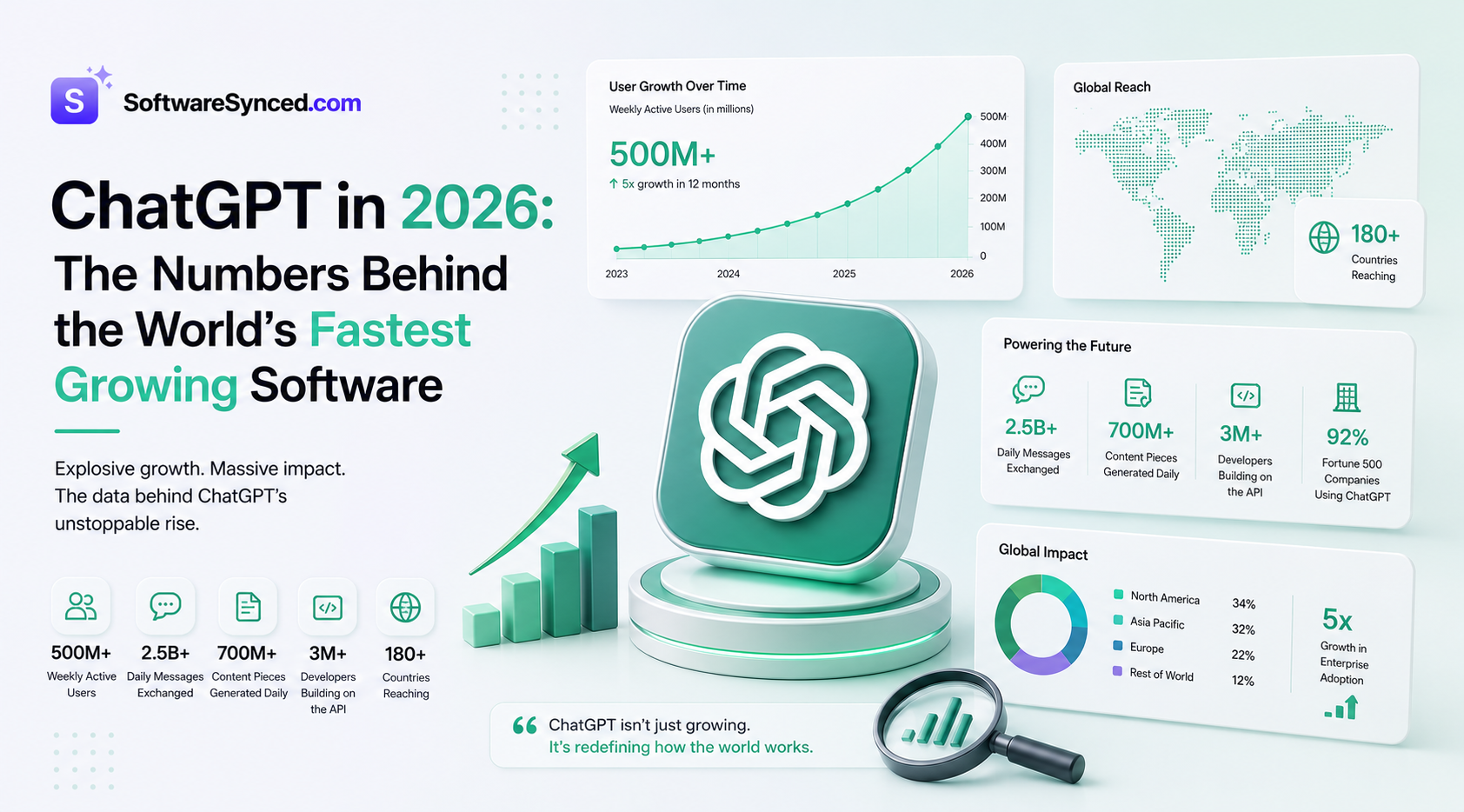
No software product in history has grown the way ChatGPT has. Two years from launch it had 100 million users. Two years after that, it had 900 million. That is not a typo. The same product that took the internet by storm in late 2022 now reaches more people every week than the entire population of Europe.
But the most interesting story about ChatGPT in 2026 is not the scale — it is the tension underneath it. OpenAI’s revenue is growing faster than almost any software company ever has. At the same time, its market share is falling. Its user base is still exploding. Its grip on the enterprise is tightening. And a wave of well-funded competitors is chipping away at the consumer dominance that made it famous.
This is the full picture — what the numbers actually say, where they come from, and what they mean for businesses, developers, and anyone navigating the AI software landscape right now.
The User Numbers: Scale That Has No Precedent
Let’s start with the headline figures, because they genuinely need to be understood at scale before the nuance makes sense.
900 million weekly active users. That is the figure OpenAI confirmed in February 2026 — up from 400 million in February 2025. The user base more than doubled in twelve months. For context, it took Facebook approximately seven years to reach 1 billion monthly active users. ChatGPT is approaching that threshold in weekly users in under four years.
The growth trajectory tells the story clearly:
| Date | Weekly Active Users |
|---|---|
| January 2023 | 100 million (monthly) |
| August 2024 | 200 million |
| February 2025 | 400 million |
| July 2025 | 700 million |
| December 2025 | 800 million |
| February 2026 | 900 million+ |
Sources: Reuters, OpenAI announcements, TechCrunch
Beyond weekly users, OpenAI reported that ChatGPT processes over 2 billion prompts per day and users collectively send 18 billion messages per week. The ChatGPT website recorded 5.72 billion total visits in January 2026 alone — ranking it among the five most visited websites globally, ahead of Wikipedia, Instagram, and X.
ChatGPT also holds the record for the most downloaded app in App Store history. The mobile app has accumulated over 1.44 billion downloads since May 2023 across iOS and Android, with a 4.9/5 rating based on more than 800,000 App Store reviews.
The Revenue Story: $25 Billion and Accelerating
User scale is one thing. Revenue is another. And OpenAI’s revenue growth is where the numbers become genuinely remarkable.
OpenAI crossed $25 billion in annualized revenue by February 2026, generating approximately $2 billion per month. For reference:
- Full-year 2023 revenue: approximately $1.6 billion
- Full-year 2024 revenue: approximately $3.7 billion
- Full-year 2025 revenue: approximately $13.1 billion
- Annualized run rate by February 2026: $25 billion+
- Full-year 2026 projection: $29.4 billion
That is roughly an 8x revenue increase over two years. The pace has no real precedent in enterprise software history. Salesforce took over a decade to reach $25 billion in annual revenue. OpenAI is on track to hit it in under five years from founding.
The enterprise shift is driving this. Enterprise revenue is now over 40% of OpenAI’s total, up from around 30% a year ago, and is on track to reach parity with consumer revenue by the end of 2026. OpenAI reports 9 million paying business users as of early 2026, up 4x from September 2025 — a growth rate that OpenAI itself described as “the fastest-growing business platform in history.”
The funding picture matches the revenue trajectory. In March 2026, OpenAI closed a $122 billion funding round at an $852 billion post-money valuation. An IPO is widely expected, though no firm timeline has been confirmed.
The Market Share Paradox
Here is where the story gets genuinely interesting — and where most coverage of ChatGPT misses the central tension.
ChatGPT’s user base is still growing. Its market share is falling sharply.
According to Similarweb data, ChatGPT’s share of generative AI web traffic fell from 87% in early 2025 to 56.7% by March 2026 — a 30-point drop in twelve months. This is the most significant market share shift in generative AI history.
The competitive landscape in March 2026 looks like this:
| Platform | March 2025 Share | March 2026 Share | Change |
|---|---|---|---|
| ChatGPT | 77.4% | 56.7% | -20.7pp |
| Google Gemini | 6.0% | 25.5% | +19.5pp |
| Claude (Anthropic) | 1.4% | 6.0% | +4.6pp |
| Others | 15.2% | 11.8% | -3.4pp |
Source: Similarweb via TechnologyChecker, March 2026
The apparent paradox resolves when you understand what is happening. The total number of people using AI chatbots is growing so fast that ChatGPT can lose market share dramatically while still adding hundreds of millions of users. The pie is expanding faster than any one player can capture.
Google’s distribution advantage is the biggest factor. Gemini’s surge from 6% to 25.5% is almost entirely explained by Google’s ability to embed Gemini natively into Search, Gmail, Google Docs, Android, and Chrome — products that collectively reach over 3 billion people. When the AI is already in the tools people use all day, switching costs disappear.
On mobile specifically, ChatGPT’s daily active user share in the US fell from 69% to 45.3% between early 2025 and early 2026, according to Apptopia data. Grok rose from 1.6% to 15.2% of the US mobile chatbot market over the same period — an extraordinary increase driven by its integration into X and Elon Musk’s personal platform.
The one outlier worth noting: Claude records 34.7 minutes of daily engagement per user — the highest of any platform tracked. ChatGPT wins on volume. Claude wins on depth of engagement. That split matters for how businesses should think about which platform to build workflows around.
Enterprise Adoption: From Experiment to Infrastructure
The narrative around ChatGPT’s business adoption shifted decisively in 2025 and 2026. It is no longer an experiment. For most large organisations, it is infrastructure.
93% of Fortune 500 companies now use ChatGPT in some capacity, according to data from Christian & Timbers. That figure encompasses everything from individual employee use to department-wide deployments to formal ChatGPT Enterprise contracts — but the breadth of the number is significant. At this point, not using ChatGPT in any form is the outlier position for large businesses.
The depth of enterprise deployment is also increasing. ChatGPT Enterprise weekly active users grew from 243 million in Q1 2025 to 837 million in Q1 2026 — a 244% year-over-year increase. Enterprise workplace seats exceeded 7 million, with enterprise seat growth up approximately 9x year-on-year. The average enterprise worker is now sending 30% more messages than a year ago, and daily work-related messages across the platform grew from 213 million to 716 million over the same period.
The ROI data is also maturing. Earlier enterprise AI adoption was characterised by pilots and experiments. In 2026, measured outcomes are increasingly available:
- BCG consultants trained on ChatGPT scored 49 percentage points higher on technical tasks than the control group in a landmark Boston University and BCG study — one of the most rigorously measured productivity findings in the enterprise AI space
- IBM research found companies realise an average return of $3.50 for every $1 invested in AI, with broader estimates reaching $3.70 when productivity gains are fully factored in
- Sales functions show the highest ROI at 420%, driven by ChatGPT’s ability to customise proposals at scale — reducing proposal creation time from 4.5 hours to 1.8 hours while improving win rates by 12%
- Customer service implementations show 340% ROI with payback periods under five months
- Marketing teams using ChatGPT consistently produce 3.2x more content per marketer per month, according to McKinsey research
The one honest caveat in the enterprise data: only 39% of organisations report enterprise-level EBIT impact from AI, and 70–85% of AI initiatives still fail to meet expected outcomes. The gap between companies seeing strong ROI and those still struggling almost always comes down to implementation structure, not the tool itself.
The Industry Breakdown: Who Is Actually Using It
Adoption is not uniform across industries. The data shows clear leaders and clear laggards.
78% of organisations now use AI in at least one business function, and 87% of large enterprises have implemented AI solutions. But the distribution across sectors is uneven.
Technology and professional services lead. Software companies, consulting firms, and marketing agencies have the highest ChatGPT penetration and the most mature deployment patterns. Three out of four marketers worldwide have used ChatGPT at least once a week for work-related tasks, according to HubSpot’s 2026 State of AI in Marketing report.
Healthcare, legal, and financial services are moving fast but cautiously. Regulatory and compliance requirements slow full deployment, but adoption within permitted use cases — documentation, research synthesis, internal knowledge management — is accelerating.
Traditional industries are further behind but closing the gap. Construction (24% adoption), energy (27%), and agriculture (19%) are implementing ChatGPT primarily for documentation and regulatory compliance rather than customer-facing applications. Construction firms report 38% time savings on project documentation, while energy companies report 42% faster regulatory filing processes.
What Businesses Are Actually Doing With It
The use cases with the highest measured ROI in 2026 are not the most glamorous. They are the ones that address volume, repetition, and the slow work that consumes disproportionate time.
Content and copy generation is the highest-volume use case across business sizes. Marketing teams use ChatGPT to draft campaign copy, product descriptions, email sequences, and blog content — often producing first drafts that require editing but still cut production time by 50–70%.
Customer support automation is where measured ROI is most consistent. Businesses using ChatGPT-powered support tools report handling significantly higher query volumes without proportional staffing increases. Response quality for standard queries is measurably higher than templated responses.
Code review and development acceleration is the fastest-growing enterprise use case. Codex, OpenAI’s coding tool, grew to over 2 million weekly users, up 5x in three months, with usage growing more than 70% month over month. Engineering teams report 22% faster feature shipping and 31% reduction in debugging time.
Document analysis and research synthesis — one of the most underreported use cases — is particularly valuable in legal, financial, and consulting contexts where professionals spend significant time processing large volumes of text before producing output.
The Traffic-to-Conversion Insight Every Marketer Should Know
One data point from this year’s ChatGPT adoption research deserves specific attention for anyone thinking about AI’s impact on how businesses reach customers.
According to a Seer Interactive case study, traffic referred from ChatGPT converts at 16% — compared to Google organic search’s 1.8%. That is nearly 9 times higher conversion for AI-referred traffic.
The caveat is important: AI-referred traffic currently accounts for less than 1% of overall organic traffic. The volume is tiny. But the intent signal is extraordinarily strong. People who arrive at a website through a ChatGPT recommendation have been through a research and recommendation process before clicking — they are not browsing, they are deciding.
For businesses that publish content — reviews, comparisons, guides — optimising for AI citation is becoming a meaningful component of content strategy. What makes AI cite your content is the same thing that makes Google rank it: clear, specific, well-sourced answers to the questions people actually ask.
What the Numbers Tell Us About 2026 and Beyond
The headline narrative — ChatGPT is losing market share — is technically accurate and contextually misleading. The more important observation is that the total AI software market is expanding at a rate that makes any single company’s share percentage less relevant than the absolute number of users and the depth of enterprise integration.
A few things the data makes clear for 2026:
OpenAI has successfully pivoted toward enterprise. With enterprise revenue approaching 40% of total and enterprise seat growth of 9x year-on-year, OpenAI is increasingly a B2B platform rather than a consumer product. That is a more durable revenue foundation than consumer subscriptions.
The market is moving toward multi-model strategies. ChatGPT’s market share is compressing as competitors mature, pushing businesses toward using different models for different tasks rather than a single-vendor approach. The question for businesses is no longer “should we use ChatGPT?” but “how do we combine models for maximum ROI at scale?”
Consumer share will keep falling; revenue will keep rising. Gemini’s distribution advantages through Google’s existing product suite are structural, not temporary. ChatGPT’s consumer market share will continue to compress. But OpenAI’s enterprise revenue trajectory — $29.4 billion projected for full-year 2026 — does not depend on consumer share dominance to remain one of the most significant financial stories in software history.
The productivity gains are real, but implementation matters more than the tool. The BCG study, IBM research, and McKinsey data all point in the same direction: ChatGPT produces measurable productivity gains when deployed with clear use cases, proper training, and governance structures. The 70–85% failure rate for AI initiatives is a human and organisational problem, not a technology one.
ChatGPT reached 100 million users faster than any product in history. It is now approaching 1 billion. The question for businesses in 2026 is not whether to use AI — that debate is settled. The question is which tools, deployed how, produce the returns that justify the investment.
This article draws on data from OpenAI announcements, Similarweb, Apptopia, McKinsey Global Institute, BCG/Boston University research, IBM, HubSpot’s State of AI in Marketing 2026, and multiple third-party ChatGPT statistics trackers. All figures cited include source links. Data points reflect the most recent available figures as of June 2026.