

Last updated: June 2026 | Reading time: 10 minutes
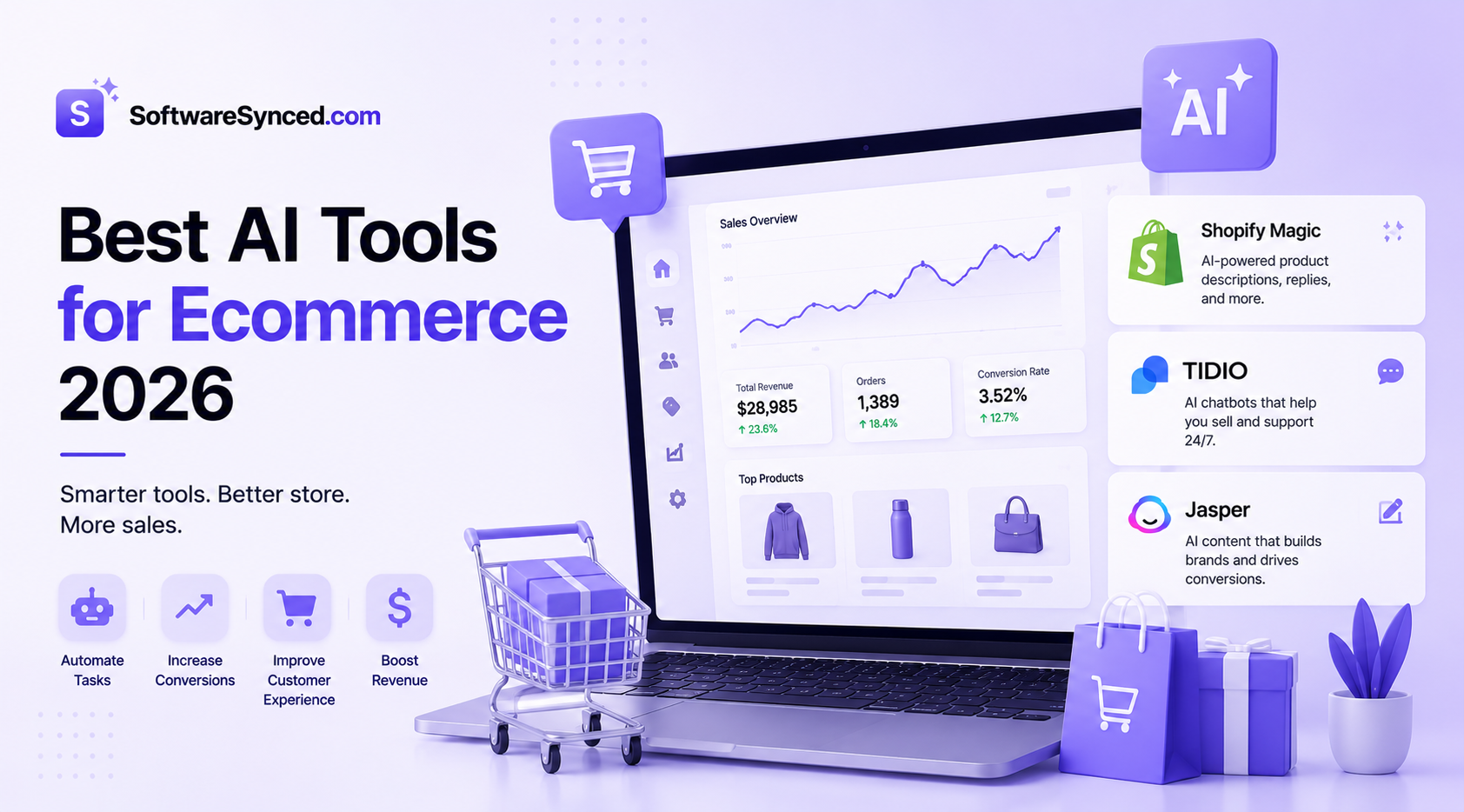
AI is no longer optional for ecommerce stores that want to compete on speed and efficiency. In 2026, the tools available to independent and mid-size stores are the same tools that large retailers were paying enterprise prices for two years ago — and the gap in results between stores using AI effectively and those that are not is widening.
The challenge is not finding AI tools. It is knowing which ones solve a real problem in your store rather than adding a subscription that duplicates what you already have.
This guide covers six AI tools across the four use cases that drive the most measurable ecommerce revenue: email and SMS marketing, customer support, content creation, and product discovery. Each tool is assessed on what it actually does, what it costs, and which type of store it is built for.
If you are still setting up your broader ecommerce marketing stack, our guide to the best ecommerce marketing tools in 2026 covers the full picture beyond AI-specific tooling.
Quick Comparison
| Tool | Use Case | Free Plan | Starting Price | Best For |
|---|---|---|---|---|
| Klaviyo AI | Email and SMS marketing | Yes (250 contacts) | ~$20/month | Ecommerce stores driving revenue from email |
| Shopify Magic | Content and store management | Free (Shopify plan required) | Included with Shopify | Shopify merchants wanting built-in AI |
| Tidio | Customer support and live chat | Yes (limited) | ~$29/month | Stores with growing support volumes |
| Gorgias AI | Customer support at scale | No | ~$10/month (Starter) | Mid-to-large stores with high ticket volume |
| Jasper | Content creation | No (7-day trial) | ~$49/month | Stores publishing content at scale |
| Rebuy | Product recommendations | No | ~$99/month | Shopify stores wanting AOV lift |
How AI Is Actually Being Used in Ecommerce in 2026
The stores getting the most value from AI in 2026 are not using it to replace strategy — they are using it to eliminate the repetitive, time-consuming execution work that sits between a good idea and a live campaign.
The four areas where AI delivers the most measurable return in ecommerce are:
Email and SMS automation — AI-generated segments, subject line optimisation, send-time prediction, and flow creation that would take a marketing team days to configure manually.
Customer support automation — AI that resolves order status queries, return requests, and product FAQs without human involvement, freeing support teams to handle conversations that actually require judgement.
Content at scale — product descriptions, ad copy, blog posts, and email copy generated in minutes rather than hours, particularly valuable for stores with large or frequently updated catalogues.
Personalisation and product discovery — AI-powered recommendations that increase average order value by surfacing relevant products at checkout, post-purchase, and in email.
The tools below are the best available in each category in 2026.
1. Klaviyo AI — Best for Email and SMS Marketing
Free plan: Yes (250 contacts) | Starting price: ~$20/month | Best for: Ecommerce stores where email drives meaningful revenue
Klaviyo is the most capable email and SMS marketing platform for ecommerce, and its AI layer — built directly into the platform rather than bolted on — is what separates it from general-purpose email tools. Every AI feature operates on your actual store data: purchase history, browse behaviour, lifetime value, and engagement patterns.
What Klaviyo AI does in practice:
Predictive analytics — Klaviyo generates individual-level predictions for every contact: expected next purchase date, predicted lifetime value, churn risk score, and ideal send time. These are not segment-level estimates — they update continuously based on real store activity.
AI-generated segments — describe in plain language who you want to reach (“customers who bought X but not Y in the last 90 days”) and Klaviyo builds the segment. This removes the technical barrier that prevents most stores from using advanced segmentation.
Marketing Agent — introduced in 2025, this AI-powered campaign builder generates complete email flows based on a brief description of your goal. It selects triggers, writes copy, and configures timing — a setup that would previously take several hours.
Subject line and send-time optimisation — Klaviyo tests subject line variants and learns the optimal send time for each individual contact based on their historical engagement patterns.
The honest trade-off: Klaviyo’s AI features are most valuable at meaningful list sizes and send volumes. At 500 contacts, the predictive layer does not have enough data to generate reliable predictions. The platform pays for itself most clearly for stores doing significant email revenue — typically those with active lists above 2,000 contacts. Pricing starts at ~$20/month and scales with active profile count.
Our Mailchimp vs Klaviyo comparison covers how Klaviyo’s AI capabilities compare to the broader email marketing landscape if you are still evaluating platforms.
Best for: Ecommerce stores on Shopify or WooCommerce that want AI-powered email automation, segmentation, and predictive analytics in a single platform.
Not ideal for: Early-stage stores with lists under 500 contacts, or businesses where email is not a primary revenue channel.
2. Shopify Magic — Best Free AI for Shopify Merchants
Free plan: Included with any Shopify plan | Starting price: Free (Shopify plan starts at ~$39/month) | Best for: Shopify merchants who want built-in AI without additional subscriptions
Shopify Magic is the most underused tool on this list for one simple reason: it is already in your Shopify dashboard if you are on any paid plan, and most merchants have not explored it properly. It is not a separate subscription — it is Shopify’s native AI layer built into the platform across content, customer messaging, and store management.
What Shopify Magic covers:
Product description generation — paste in your product details and Shopify Magic generates SEO-friendly descriptions instantly. For stores with large catalogues, this alone saves significant time.
Email subject lines and body copy — generate campaign copy and subject line variants directly within Shopify Email without switching tools.
Shopify Sidekick — an AI assistant built into the Shopify admin that answers operational questions, runs reports, and takes actions in your store based on plain-language instructions. Ask it to “show me my top 10 products by revenue this month” or “create a 20% discount code for returning customers” and it handles it directly.
Image editing and background removal — AI-powered product image editing built into the media manager, removing the need for external design tools for standard product photography tasks.
The limitation: Shopify Magic is a general-purpose AI layer, not a specialist tool. Its email features are less capable than Klaviyo AI. Its support automation does not compare to Gorgias or Tidio. Its content output is a solid starting point but typically requires editing before publishing. Think of it as the AI tool you use while you are still building — and as a permanent free complement to specialist tools once you have them in place.
Best for: Every Shopify merchant — there is no reason not to use it given it is included. Particularly valuable for stores that are not yet ready to invest in specialist AI tools.
Not ideal for: Stores that need deep AI automation across email, support, or recommendations — Shopify Magic is a broad tool, not a deep one.
3. Tidio — Best AI Support for Growing Stores
Free plan: Yes (limited to 50 conversations/month) | Starting price: ~$29/month | Best for: Stores with growing support volumes that need AI chat without enterprise pricing
Tidio is the most accessible AI customer support tool for independent and mid-size ecommerce stores. Its AI chatbot — powered by Lyro, its own conversational AI engine — handles customer queries in natural language, connecting to your store data to answer questions about order status, returns, shipping, and product availability without human intervention.
In practice, Tidio’s Lyro handles the queries that make up the bulk of most ecommerce support queues: “Where is my order?”, “Can I return this?”, “Do you ship to [country]?”, “What size should I get?”. For stores receiving 50–500 support queries per day, automating these frees the support team for conversations that require human judgement — complaints, high-value pre-sale questions, edge cases.
Tidio integrates natively with Shopify, WooCommerce, and BigCommerce, pulling in real order data so the AI can give accurate responses rather than generic deflections. Live chat escalation routes to human agents when the AI cannot resolve a query, with the full conversation context carried through.
The trade-off: Tidio’s AI is effective for standard query types but less capable at multi-step or complex issue resolution than enterprise tools like Gorgias AI or Intercom Fin. For stores with high ticket volumes requiring order modifications, partial refunds, or complex logistics queries, the AI will escalate more frequently than dedicated enterprise tools. For most growing stores, that limitation is acceptable given Tidio’s significantly lower price point.
Best for: Ecommerce stores receiving growing support volumes that want AI chat automation at a price point suitable for independent businesses.
Not ideal for: High-volume stores where support automation needs to complete complex multi-step actions like issuing refunds or modifying orders autonomously.
4. Gorgias AI — Best for High-Volume Customer Support
Free plan: No | Starting price: ~$10/month (Starter, up to 50 tickets/month) | Best for: Mid-to-large ecommerce stores with significant daily support volume
Gorgias is the leading customer support platform for Shopify stores doing meaningful volume, and its AI automation layer is built specifically around ecommerce workflows rather than general helpdesk use cases. Unlike Tidio, Gorgias AI is designed to resolve issues completely — not just deflect them — by connecting directly to your order management system, Shopify backend, and payment processor.
What this means in practice: when a customer asks about a return, Gorgias AI does not just explain your return policy — it can initiate the return process, generate a label, and confirm the action, all within the same conversation. When a customer asks for an order modification, it can check fulfilment status and make the change if the order has not shipped. This resolution depth is what separates Gorgias from lighter-touch support tools.
Key features that matter for ecommerce:
- Revenue statistics — tracks revenue influenced by support conversations, making the business case for support investment visible
- Macro automation — AI-suggested response templates based on historical ticket patterns, speeding up human agent responses for queries the AI cannot fully resolve
- Intent detection — classifies incoming tickets by type automatically (order status, return, complaint, pre-sale) and routes them accordingly
- Shopify sidebar — every ticket shows full customer order history, lifetime value, and previous conversations in a single view
The honest trade-off: Gorgias pricing scales with ticket volume — the Starter plan at $10/month only covers 50 tickets per month. Stores with real volume will quickly move to the Basic tier at ~$60/month (300 tickets) or Pro at ~$360/month (2,000 tickets). At those price points, Gorgias needs to be replacing meaningful staff time to justify the cost. For stores receiving 100+ support tickets daily, it typically does. For smaller stores, Tidio’s lower-cost AI is the better starting point.
Best for: Mid-to-large ecommerce stores with high daily support volume that need AI capable of completing actions — not just answering questions.
Not ideal for: Early-stage stores with low support volume — Gorgias’ pricing model does not deliver strong value until ticket volume justifies the per-ticket cost.
5. Jasper — Best for Content Creation at Scale
Free plan: No (7-day trial) | Starting price: ~$49/month | Best for: Stores publishing significant amounts of content — product descriptions, blog posts, ad copy, email campaigns
Jasper is the most capable AI writing tool for ecommerce content in 2026, built specifically for marketing and commercial copy rather than general writing. For stores with large catalogues that need product descriptions, stores running content marketing alongside their ecommerce operation, or teams managing paid social and email copy simultaneously, Jasper scales the output of a small team to what would previously require a larger one.
What it does well for ecommerce specifically:
Product description generation at scale — paste in product specs, brand guidelines, and tone of voice, and Jasper generates SEO-optimised descriptions across your entire catalogue. For stores with hundreds of SKUs or frequently updated inventory, this removes one of the most time-consuming content tasks.
Ad copy and A/B variants — generate multiple variants of Facebook, Instagram, and Google ad copy for the same product without starting from scratch each time. Testing copy variants is one of the highest-ROI activities in paid advertising, and Jasper makes the generation fast enough that testing more variants becomes practical.
Brand voice consistency — Jasper’s brand voice feature trains the AI on your existing copy and tone guidelines, keeping output consistent across writers and output types.
Blog and SEO content — for stores running content marketing as part of their organic acquisition strategy, Jasper generates long-form content faster than human writers while maintaining keyword integration.
The trade-off: Jasper produces strong first drafts, not finished copy. Output requires editing before publishing — both for accuracy and to match the nuance that human writers bring. For stores where brand voice and copy quality are core differentiators, Jasper speeds up the process but does not replace editorial judgement. For stores where output volume matters more than copy sophistication, the time savings are significant.
For an AI writing tool comparison in a broader context, our guide to the best AI writing tools in 2026 covers Jasper alongside other options across different use cases.
Best for: Stores with large catalogues needing product descriptions at scale, ecommerce brands running content marketing, and teams managing high volumes of ad copy.
Not ideal for: Stores where brand voice and copy nuance are primary differentiators — Jasper’s output is strong but requires editing.
6. Rebuy — Best for Product Recommendations and AOV
Free plan: No | Starting price: ~$99/month | Best for: Shopify stores with meaningful traffic that want to increase average order value through AI-powered recommendations
Rebuy is the most capable AI product recommendation engine for Shopify in 2026, and its single job is increasing average order value by surfacing the right products to the right customer at the right moment in the purchase journey. It does this at checkout, post-purchase, in email, and on product pages — using purchase history, browse behaviour, and real-time cart data to personalise recommendations individually rather than showing the same “customers also bought” block to every visitor.
Where Rebuy earns its cost most clearly:
Smart Cart — an AI-powered cart upgrade that replaces Shopify’s default cart with a dynamic experience showing personalised upsell and cross-sell recommendations in real time as items are added.
Post-purchase offers — one-click upsell offers presented immediately after checkout, before the order confirmation screen. These convert at a higher rate than any pre-purchase upsell because the customer is in the highest-intent moment of the purchase journey.
Reorder automation — for consumable products, Rebuy identifies repurchase timing based on individual order history and sends personalised reorder prompts via email or SMS.
In-email recommendations — integrates with Klaviyo to populate email templates with personalised product recommendations based on each contact’s actual purchase and browse history.
The honest trade-off: at ~$99/month for the Starter plan, Rebuy requires meaningful traffic and revenue to justify. The benchmark is approximately $25,000+ in monthly revenue — at that level, a 5–10% AOV increase from personalised recommendations generates returns that comfortably cover the subscription. Below that threshold, the investment is harder to justify and Shopify’s native recommendation features may be sufficient.
Best for: Shopify stores doing meaningful monthly revenue that want AI-powered personalisation to increase average order value at checkout and post-purchase.
Not ideal for: Early-stage stores with low traffic volumes — Rebuy’s AI requires sufficient data and revenue to deliver a measurable return.
Which Tools Should You Start With?
The right answer depends on where your store is losing money or time right now.
If you are just starting out: Shopify Magic (free if you are on Shopify) and Klaviyo’s free tier cover the highest-impact use cases — content generation and email automation — at no additional cost. That is the right starting point before any paid AI subscription.
If email is your primary revenue channel: Klaviyo AI at ~$20/month is the highest-ROI paid tool on this list for most ecommerce stores. Automated flows powered by predictive data outperform manually configured email consistently.
If support is consuming team time: Tidio at ~$29/month handles the majority of standard support queries autonomously. Upgrade to Gorgias when daily ticket volume makes Tidio’s limitations a constraint.
If you publish content regularly: Jasper at ~$49/month pays for itself once it is replacing meaningful writing time. For stores with 100+ SKUs or weekly content publishing, the time savings are clear within the first month.
If AOV is your focus: Rebuy at ~$99/month is the right investment once your store is doing consistent monthly revenue above $25,000.
Final Verdict
The ecommerce stores winning with AI in 2026 are not using every tool available — they are using three or four tools that solve specific, measurable problems and have given those tools enough time to generate reliable data.
Start with Shopify Magic because it is free. Add Klaviyo AI because email automation is the highest-ROI channel for most ecommerce stores. Add Tidio or Gorgias when support volume justifies it. Add Jasper when content is a bottleneck. Add Rebuy when average order value becomes the primary lever for growth.
If you are still building your broader ecommerce marketing stack, our guide to the best ecommerce marketing tools in 2026 covers the full landscape — and our guide to ecommerce email marketing explains how to make email the revenue engine it should be before layering AI on top.