
Last updated: May 2026 | Reading time: 9 minutes
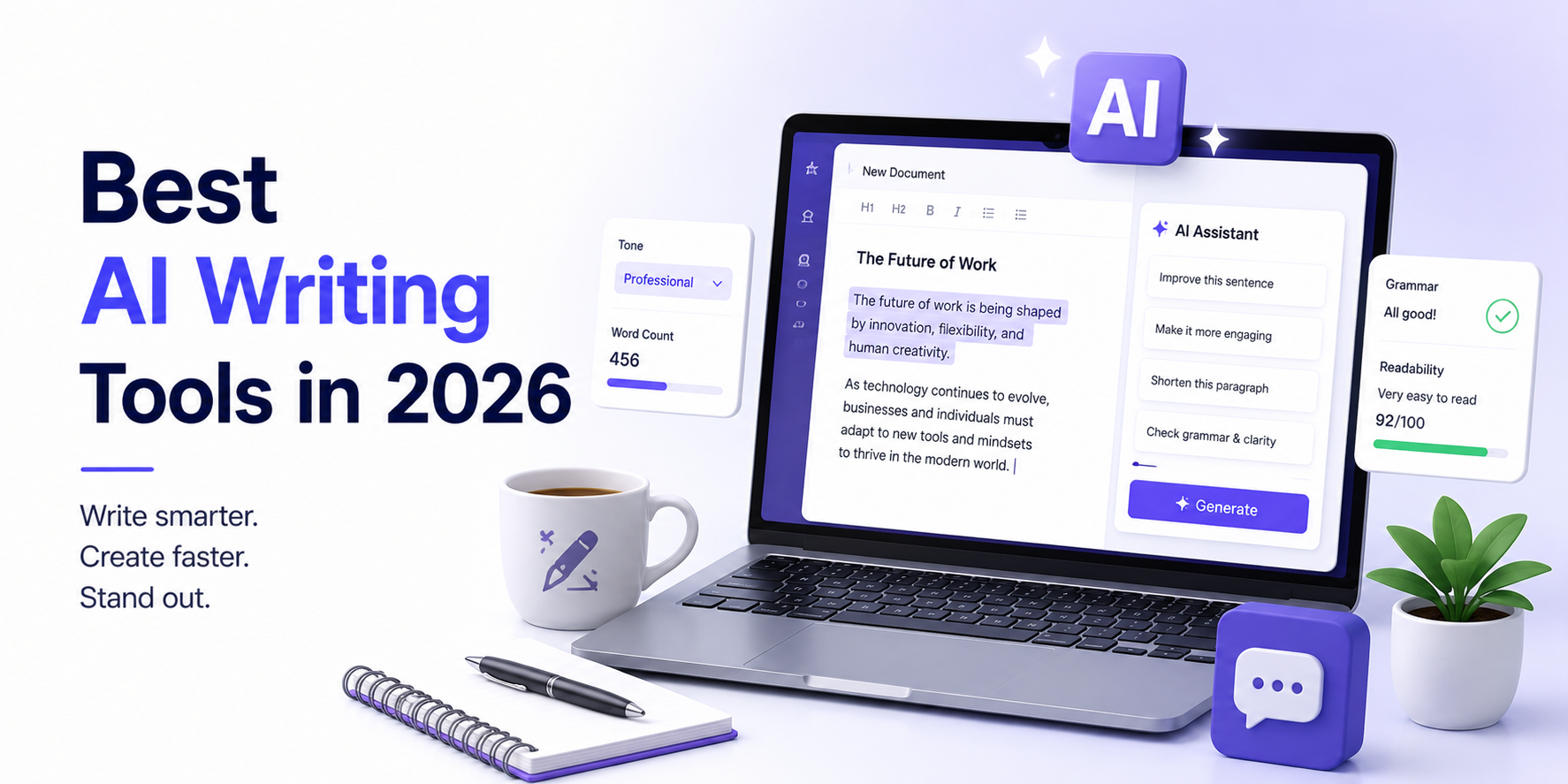
AI writing tools have gone from novelty to necessity. In 2026, the question is no longer whether to use one — it’s which one is actually worth your money. The market has matured and splintered: on one side, general-purpose AI assistants like ChatGPT and Claude have become capable enough that many writers need nothing else. On the other, specialised platforms for marketing, SEO, and brand consistency have carved out legitimate niches.
This guide covers the best AI writing tools available right now — what each one does well, where it falls short, and who it’s actually built for. No affiliate spin, just honest assessments.
Quick Comparison
| Tool | Free Plan | Starting Price | Best For |
|---|---|---|---|
| ChatGPT | Yes (limited) | $20/month | All-round versatility |
| Claude | Yes (limited) | $20/month | Natural long-form writing |
| Jasper | No | $49/month | Marketing team brand consistency |
| Writesonic | Yes | $16/month | Budget SEO content creation |
| Grammarly | Yes | ~$12/month | Editing and polishing |
| Copy.ai | Yes | $49/month | Sales and marketing automation |
1. ChatGPT (OpenAI) — Best All-Round General Purpose Tool
Pricing: Free (limited). Plus at $20/month. Team at $25/user/month. Pro at $200/month.
Best for: Bloggers, freelancers, and generalists who switch between content types daily and need one tool that handles everything reasonably well.
ChatGPT remains the most versatile general-purpose AI writing tool on the market. Its breadth is unmatched — it handles blog posts, emails, social captions, outlines, research summaries, and code equally well. The Canvas feature (a side-panel editor for targeted rewrites) and persistent memory across conversations have made it significantly more useful for writers compared to earlier versions. For most solo writers, ChatGPT Plus at $20/month handles the vast majority of everyday writing needs.
What’s genuinely great:
- Largest ecosystem of integrations and third-party plugins
- Excellent for research, brainstorming, and structuring complex content
- Projects feature keeps workflows organised across multiple clients or topics
- Versatile enough to replace several standalone tools
Honest downsides:
- The free plan hits rate limits quickly and locks you out of the best models for stretches of time
- Lacks dedicated brand voice memory and SEO-specific features that specialist tools offer
- Output can feel structured and efficient but occasionally lacks the natural flow of human writing
- Requires strong prompting discipline to get consistently good results — the tool rewards skill
Verdict: The safest starting point for most writers. If you only subscribe to one AI writing tool, ChatGPT Plus is the most flexible choice. Add a specialist tool only when you hit a clear limitation.
2. Claude (Anthropic) — Best for Natural Long-Form Writing
Pricing: Free (limited). Pro at $20/month. Team and Enterprise plans available.
Best for: Bloggers, journalists, thought leaders, and anyone producing content that needs to sound genuinely human rather than AI-generated.
Claude has earned a strong reputation for producing the most natural, nuanced prose of any AI writing tool currently available. Where ChatGPT excels at breadth and structure, Claude excels at depth and tone. It listens to stylistic instructions — “write like a human, no em dashes, no AI fluff” — more reliably than most competitors, making it particularly valuable for writers who care about voice. Its 200,000 token context window also means it can handle extremely long documents without losing coherence.
What’s genuinely great:
- Best-in-class output quality for long-form, essay-style, and nuanced writing
- Follows tone and style instructions more reliably than most competitors
- Handles very long documents without losing context or coherence
- Strong for editing, rewriting, and improving existing drafts
Honest downsides:
- Less versatile than ChatGPT for non-writing tasks like research or coding assistance
- Smaller third-party ecosystem compared to OpenAI
- Free plan is more limited in daily usage than ChatGPT’s free tier
- Not purpose-built for SEO or marketing workflows
Verdict: The top choice if writing quality is your primary concern. Particularly strong for long-form content, nuanced articles, and anything where sounding human matters. Many professional writers use Claude for drafting and ChatGPT for research — the two complement each other well.
3. Jasper — Best for Marketing Teams Needing Brand Consistency
Pricing: Creator at $49/month. Pro at $69/month. Business at custom pricing.
Best for: Marketing departments and content teams that need consistent brand voice across multiple writers, campaigns, and channels.
Jasper has evolved significantly from its early days as a simple AI copywriter. In 2026 it positions itself as a full content operations platform — with brand voice training, campaign management, team collaboration, and workflow automation built in. It is built on a proprietary fine-tuned model layered on top of GPT-4 class architecture, which gives it notably stronger performance on marketing-specific tasks compared to raw API outputs. For teams producing high volumes of brand-controlled content, the structure Jasper provides is genuinely valuable.
What’s genuinely great:
- Brand voice training is among the best available — stays consistent across all outputs
- Extensive template library covering ads, emails, landing pages, social content, and more
- Campaign workflow features that general AI tools simply do not offer
- Strong collaboration tools for content teams with multiple contributors
Honest downsides:
- Expensive compared to general-purpose tools — hard to justify for solo writers
- Overage fees can catch you off guard if usage is underestimated
- Premium integrations (Surfer SEO, Grammarly, Copyscape) often carry separate fees
- For a freelancer managing multiple clients, the single-brand focus on lower plans is limiting
Verdict: A legitimate investment for marketing teams producing large volumes of brand-controlled content. Overkill and overpriced for individual writers or small operations. If you’re a solo creator, ChatGPT or Claude will serve you better at a third of the cost.
4. Writesonic — Best Budget Option for SEO Content
Pricing: Free plan available. Standard at $16/month. Professional at $79/month.
Best for: Freelancers, bloggers, and small-to-medium businesses that need high-volume, SEO-friendly content without enterprise-level pricing.
Writesonic strikes a strong balance between output quality and affordability, making it one of the most recommended tools for solo content creators in 2026. Its built-in SEO mode suggests keywords as you write, and its article generation is fast with output that typically requires minimal editing. It also includes chatbot features for those building AI-powered customer interactions on a budget. For someone building a content-driven website or blog, Writesonic offers a lot of functionality at a price point that is hard to argue with.
What’s genuinely great:
- Most affordable paid plan of any major AI writing tool at $16/month
- Built-in SEO keyword suggestions integrated directly into the writing workflow
- Fast article generation with consistently clean output
- Wide range of content types covered — ads, blog posts, product descriptions, social content
Honest downsides:
- Free plan is limited — you will hit the word limit quickly if producing content daily
- Brand voice memory and workflow customisation are not as polished as Jasper
- Does not match Jasper’s depth for teams needing multi-campaign management
- Output quality, while good, occasionally needs more editing than Claude or ChatGPT
Verdict: The best budget pick for independent content creators and small businesses. If you are building a content-driven site like a tech news or review blog and want SEO tools built in, Writesonic is worth starting with before committing to pricier platforms.
5. Grammarly — Best for Editing and Polishing Existing Content
Pricing: Free plan available. Pro at ~$12/month (billed annually). Business plans available.
Best for: Writers who already produce their own content (or use AI drafts) and want a reliable layer of editing, grammar correction, and clarity improvement.
Grammarly occupies a different category from the other tools on this list — it does not generate content from scratch. Instead it improves what you have already written. In 2026, Grammarly has expanded well beyond grammar checking into full AI-assisted rewriting, tone adjustment, clarity scoring, and plagiarism detection. It integrates directly into browsers, Google Docs, Microsoft Word, and most writing environments, making it a passive but powerful presence in any writing workflow.
What’s genuinely great:
- Works everywhere — browser extension, Google Docs, Word, email clients
- Catches not just grammar errors but clarity, conciseness, and tone issues
- Tone detector helps ensure your content hits the right register for your audience
- Plagiarism checker is built in on Pro plans — useful for content sites
Honest downsides:
- Not a content generator — you still need another tool to produce first drafts
- The free plan catches basic errors but misses many style and clarity improvements
- AI rewriting suggestions on Pro are useful but not as sophisticated as dedicated AI writers
- Annual billing locks you in — monthly billing is significantly more expensive
Verdict: An essential add-on for any serious writer, not a standalone AI writing tool. Pair it with ChatGPT or Claude for drafts and Grammarly for polish — that combination covers most writing needs comprehensively and affordably.
6. Copy.ai — Best for Sales and Marketing Workflow Automation
Pricing: Free plan available. Starter at $49/month. Advanced at $249/month.
Best for: Sales and marketing teams that need automated content workflows — email sequences, ad variations, GTM campaigns — rather than primarily long-form writing.
Copy.ai has pivoted significantly from its origins as a general AI copywriter. In 2026 it focuses heavily on sales and go-to-market workflow automation, making it a distinctly different product from Jasper despite being frequently compared to it. It is beginner-friendly, offers a wide range of templates, and is well-suited for small businesses and freelancers needing quick, polished marketing copy across multiple formats. Its Starter plan offers unlimited words at an accessible price point, which is a genuine advantage over word-capped alternatives.
What’s genuinely great:
- Unlimited words on the Starter plan — no worrying about hitting word limits
- Beginner-friendly interface with a broad template library
- Strong for short-form marketing copy — ads, email subject lines, product descriptions
- Sales workflow automation features that dedicated writing tools do not offer
Honest downsides:
- Advanced plan at $249/month is expensive — hard to justify unless workflow automation is a core need
- Long-form content quality does not match Claude or ChatGPT
- Less depth than Jasper for brand voice training and campaign management at scale
- The pivot toward sales automation means it is less useful for pure content creators
Verdict: A solid choice for small businesses and marketers who need a range of short-form copy at a reasonable price. If sales and marketing workflow automation is important to your operation, Copy.ai fills a gap that pure writing tools do not. For long-form content, look elsewhere.
Which Tool Should You Choose?
- Just starting out and need one tool? Start with ChatGPT Plus or Claude Pro — both at $20/month cover most writing needs without paying for features you will not use yet.
- Running a content site or blog focused on SEO? Writesonic at $16/month gives you SEO tools built in at the lowest price point.
- Managing a marketing team with multiple writers? Jasper is worth the investment for brand consistency and campaign workflows.
- Already writing your own content and just want better output? Add Grammarly Pro as an editing layer on top of whatever you already use.
- Need marketing copy and workflow automation for sales? Copy.ai fills that specific gap well.
One important note: most successful content teams use two to three tools together rather than searching for one perfect platform. A general-purpose AI assistant for drafts, a specialised tool for your primary use case, and Grammarly for editing is the combination that tends to produce the best results. That tool does not exist — and chasing it wastes time and money.
Final Thoughts
The AI writing tool market in 2026 is mature enough that no single platform dominates every use case. The writers getting the best results are not the ones with the most expensive subscriptions — they are the ones who matched the right tools to their specific workflow and learned to prompt effectively.
Start simple. Test at least two or three tools on your actual content before committing to a paid plan. And remember: the best AI writing setup is the one you will actually use consistently.